Author: mylifeduas@gmail.com

  • Bahairah- The Monk who met The Messenger Of Allah

    Bahairah- The Monk who met The Messenger Of Allah

    Bahairah- The Monk who met
    The Messenger Of Allah (Peace and blessings be upon him).

    Abu Taalib would often travel to Ash-Sham (Syria and
    surrounding regions) and elsewhere for business purposes. On
    one such journey, he took the Prophet (Peace and blessings be upon him) along with him; also
    accompanying them were Makkah’s chieftains.

    When their caravan overlooked the monastery of the monk Buhairah, they
    made camp and began to unload some of their supplies.
    Meanwhile, to their surprise, Buhairah was coming out to meet
    them. What was so surprising was that though they had
    frequently stopped beside his monastery on previous business
    trips, he would never come out to meet them or even pay any
    attention to them at all.

    As they were removing some of their things, Buhairah began to
    walk among them, until he reached the Messenger of Allah (Peace and blessings be upon him)
    when he stopped, took the Messenger (Peace and blessings be upon him) by the hand, and
    exclaimed, “This is the chief of ‘Alaameen (i.e., mankind, jinns,
    etc.).

    This is the Messenger of the Lord of all that exists. Allah will
    send him as a (form of) mercy to all that exists’ The chieftains of
    the Quraish said, “And what makes you know this?” He said,
    “When you overlooked (this place), as you were arriving from
    ‘Aqaba, every single tree and stone (in the area) fell down in
    prostration, and they do not perform prostration for anyone except
    a Prophet. And indeed, I know him from the seal of Prophethood
    that resembles an apple (in shape) and that is located below his
    shoulder blade’

    He returned to his monastery for a while in order to prepare food
    for them. When he returned with the food, the Messenger of Allah (Peace and blessings be upon him) was busy watching over their camels. Buhairah requested that
    they call him to join them in their meal. He came to them, and there
    was a cloud above him giving him shade. When he arrived, he
    found that everyone else had beaten him to the shade of the tree;
    nonetheless, when he sat down, the shade moved towards him and
    covered him. Seeing this, Buhairah said, “Look! The shade of the
    tree has moved to cover him’

    Buhairah told Abu Taalib and the other chieftains that they
    should return with the Prophet (Peace and blessings be upon him) to their homeland; he
    particularly pleaded with them not to take him to the lands of
    the Romans, for if the Romans were to know about him and were
    to see the signs of his Prophethood, they would certainly kill him.

    As he was explaining this to them, he turned around and saw
    seven Romans approaching. He went to them and asked them
    what they wanted. They said, “News has reached us that the
    (awaited) Prophet is coming out during this month. Every road
    has been blocked with guards, and we were sent to watch over
    this road’ Buhairah said to them, “Suppose Allah wants a matter
    to be fulfilled; can any person prevent that from happening?”

    They said, “No.” He said, “Then pledge allegiance to him.” They
    then joined the chieftains of the Quraish and did no harm to the
    Prophet (Peace and blessings be upon him)

    But by this point, Buhairah was becoming very
    worried; he had managed to convince these guards to leave the
    Prophet (Peace and blessings be upon him) alone, but there was no telling whether more guards
    were on the way or whether the Prophet (Peace and blessings be upon him) would be identified at
    a Roman checkpoint. And so he said to the chieftains of the
    Quraish, “I insist that you tell me who his guardian is.” They said,
    “Abu Taalib is his guardian.” Buhairah then continued to plead
    with Abu Taalib until the latter finally took his advice to heart and
    sent the Prophet (Peace and blessings be upon him) back home to Makkah”

    The story of Buhairah provides us with many insights into the life
    of the Prophet(Peace and blessings be upon him)

    First, we learn that not all priests and rabbis distorted their
    revealed books. There were some among them, albeit very few in
    number, who were sincere and truthful, and who openly
    acknowledged that Muhammad (Peace and blessings be upon him) was indeed a Messenger to
    all of mankind; they knew this from the signs and descriptions
    that they found in their revealed books.

    Second, by the command of Allah, inanimate objects would
    honour the Prophet (Peace and blessings be upon him) , a fact that is established in various
    narrations. Some narrations describe how a particular stone
    would greet the Prophet (Peace and blessings be upon him) , one particular narration describes
    how a tree wept when the Prophet (Peace and blessings be upon him) stopped delivering sermons
    beside it; and the above-mentioned narration describes how trees
    and stones performed prostration to the Prophet (Peace and blessings be upon him) as a way of
    honouring him.

    Third, as precocious as he was by inherent nature, the Prophet (Peace and blessings be upon him)
    also benefited from accompanying his uncle on business trips and benefited from the
    experiences and knowledge of wise men from both the Quraish
    and foreign tribes.

    Fourth, Buhairah knew that if the Romans found out about the
    Prophet (Peace and blessings be upon him) they would kill him. This was significant because, at
    the time, the Roman Empire extended into the lands of the Arabs,
    particularly Ash-Sham (Syria and surroundings regions). And so
    the Romans knew that the awaited Messenger, who was to come
    from the Arabs, would bring an end to their imperial control over
    the region. Since the Prophet (Peace and blessings be upon him) was a threat to the interests of
    their empire, Romans both feared him and ardently desired to
    first find him and then kill him.

    ”Indeed,Allah and His angels send blessings on the Prophet: O you who have believed, Send ye blessings on him, and salute him with all respect” [33:56]
    Click here to read and download the pic of Durood-e-Paak (to send peace and blessings on our HOLY PROPHET (PEACE BE UPON HIM)

  • How Allah Protected The Prophet (sallallaahu ‘alaihi wa sallam) During The Early Years Of His Life

    How Allah Protected The Prophet (sallallaahu ‘alaihi wa sallam) During The Early Years Of His Life

    Even during the pre-Islamic days of ignorance, Allah protected
    the Prophet (Peace be upon him) from idol worship and from all forms of
    polytheism.

    ‘Urwah related that Khadeejah’ s (Radi Allahu anha) neighbour –
    during pre-Islamic times – informed him that he once heard the
    Prophet (Peace be upon him) say to Khadeejah (Radi Allahu anha) , “O Khadeejah, by Allah, I will
    never worship Al-Laat and Al-‘Uzzaa.”
    These were the names of idols that the Quraish would worship.

    Also, both the Prophet (Peace be upon him)
    and Zaid ibn ‘Amr ibn Nufail (may Allah have mercy on him)
    would abstain from eating the meat of animals that were
    slaughtered by other than the Name of Allah.

    To be sure, Allah protected the Prophet(Peace be upon him) from the vile deeds
    that result from the recklessness of youth; but He also protected
    the Prophet(Peace be upon him) from lesser sins as well.

    Ali ibn Abi Taalib reported that he heard the Messenger of Allah (sallallaahu ‘alaihi wa sallam)
    say, “I never resolved to do any of bad things that the people of ignorance
    would resolve to do, except on two occasions in life; and on both
    occasions, Allah protected me from perpetrating those bad things.

    One night, I was north of Makkah in the company of a young man
    from the Quraish; we were with his family’s sheep, which he was
    herding, when I said to him, “Watch over my sheep, so that I can
    while away this evening with conversation and entertainment in
    Makkah, just as other youth while away their evenings with
    conversation and entertainment.” He said, “Yes” and so I set out
    (for Makkah).

    When I reached the nearest house from the houses
    of Makkah, I heard singing, the striking of Dufoof (drum-like
    instruments), and (the sound of) pipes. I asked, “What is this?

    They (people nearby perhaps) said, ‘Such and such man married
    such and such woman. It was a man from the Quraish who had
    married a woman from the Quraish. And so I amused myself with
    that singing and with those sounds until sleep overcame me (right
    there where I was), and then the only thing that woke me up was
    the heat of the sun, and so I returned.

    He (i.e., the other shepherd)
    asked, “What did you do? I informed him (about what had
    happened). Then I made a similar request to him on another
    night, and he agreed. I set out (towards Makkah), and I heard
    sounds that were similar (to the sounds of the earlier night), and
    words similar to what was spoken to me (on the earlier night)
    were spoken to me (again). I amused myself with what I heard,
    until sleep overcame my eyes. And it was only the touching of the
    sun that awoke me. Then I returned to my companion, who said,
    ‘What did you do?’ I said, ‘I didn’t do anythin’ By Allah, after
    that, I never again resolved to perpetrate the evil that the people
    of ignorance would perpetrate.

    I continued upon that (protected
    state) until Allah honoured me by making me His Prophet.”*

    This Hadeeth clarifies two important realities:

    1) The Prophet (Peace and blessings be upon him) possessed the main characteristics that are
    common to all human beings. He felt the same inward
    inclinations and desires that all young people feel, and he
    understood what it meant to while away the hours of the night
    with conversation and entertainment.

    He knew that evenings spent in such a manner were enjoyable, and within
    himself his soul was saying to him, ” Would that you enjoyed
    some of the things that other people enjoy.”

    2) Despite the above-mentioned natural inclinations and desires,
    Allah protected the Prophet (Peace and blessings be upon him) from all forms of evil and
    from anything that was not in harmony with the message for
    which he was being prepared.

    May Allah guide us to the straight path,make us adhere to the Sunnah of our Holy Prophet (Peace and blessings be upon him) and save us from all the evil and deception of this world, ameen


  • Prophet Muhammad (Peace be upon him) worked as a shepherd

    Prophet Muhammad (Peace be upon him) worked as a shepherd

    Prophet Mohammad (Peace be upon him) worked as a shepherd.

    Being of noble lineage does not guarantee financial stability, a fact
    that Abu Taalib knew all too well. When the Prophet (Peace be upon him) was still
    young, Abu Taalib was going through a financial crisis; he had
    many mouths to feed, and business wasn’t going so well.

    To help his uncle get through those hard times, the Prophet (Peace be upon him) worked as
    a shepherd. In an authentic Hadeeth, the Messenger of Allah
    said, “Every Prophet that Allah sent herded sheep (at one time or
    another during his life).”

    The Companions said, “And even
    you?” He (Peace be upon him) said, “Yes, I herded them upon Qaraareet (Ibn Hajar
    said that scholars mention two possible meanings of Qaraareet: it
    is either a place in Makkah, or it is a portion of a dinaar or dirham,
    in which case the Prophet (Peace be upon him) was mentioning his wages for the
    people of Makkah.”

    Working as a shepherd allowed the Prophet (Peace be upon him) to work in peace
    and quiet, to enjoy the beauty of the desert, and to contemplate the
    wonders and beauty of Allah’s creation. Through his work, a
    shepherd picks up and develops many wonderful qualities,
    qualities that the Prophet (Peace be upon him) needed to lead his nation.

    Indeed, Allah most certainly could have provided the Prophet (Peace be upon him)
    with wealth and comfort, so that he would not have had to
    work as a shepherd. But instead, he was being trained, and his
    nation was being taught a lesson: The most honourable way to
    live is to eat from what one earns through lawful work.

    One who invites others to Islam must especially avoid taking from
    what is in the hands of others; he must be independent of all
    human beings. A self-sufficient man is dignified in the eyes of
    others; whatever good he does, he does for Allah. That every
    Prophet worked – as is mentioned in the above-mentioned
    Hadeeth – is one of many proofs that refute the accusation that
    polytheists leveled against Prophets.

    Bukhaaree related from Al-Miqdaam that the Messenger of
    Allah said, “No one has ever eaten better food than that which
    he eats from what he works at with his hand. And verily, the
    Prophet of Allah, Daawood, would eat from the work of his
    hand”

    When one is self-sufficient, depending upon no one but Allah
    one gains the freedom of being able to speak the truth. Because
    they are dependant upon the generosity of others, many people
    bow their heads low before evildoers, remaining silent about their
    wrongdoing because they fear losing their jobs and their
    livelihood.

    It was certainly easy upon Allah to provide a comfortable and
    easy existence for the Prophet (Peace be upon him)
    so that he would have no
    pressing reason to work all day in the heat of the desert, serving
    his flock. But Allah’s Wisdom dictated that the Prophet (Peace be upon him)
    and all Muslims – instead learn an important lesson: the best wealth a
    person gains is the wealth he earns through hard work.

    ”Indeed,Allah and His angels send blessings on the Prophet: O you who have believed, Send ye blessings on him, and salute him with all respect” [33:56]
    Click here to read and download the pic of Durood-e-Paak (to send peace and blessings on our HOLY PROPHET (PEACE BE UPON HIM)

  • Prophet Muhammad (Peace be upon him) worked as a shepherd

    Prophet Muhammad (Peace be upon him) worked as a shepherd

    Prophet Mohammad (Peace be upon him) worked as a shepherd.

    Being of noble lineage does not guarantee financial stability, a fact
    that Abu Taalib knew all too well. When the Prophet (Peace be upon him) was still
    young, Abu Taalib was going through a financial crisis; he had
    many mouths to feed, and business wasn’t going so well.

    To help his uncle get through those hard times, the Prophet (Peace be upon him) worked as
    a shepherd. In an authentic Hadeeth, the Messenger of Allah
    said, “Every Prophet that Allah sent herded sheep (at one time or
    another during his life).”

    The Companions said, “And even
    you?” He (Peace be upon him) said, “Yes, I herded them upon Qaraareet (Ibn Hajar
    said that scholars mention two possible meanings of Qaraareet: it
    is either a place in Makkah, or it is a portion of a dinaar or dirham,
    in which case the Prophet (Peace be upon him) was mentioning his wages for the
    people of Makkah.”

    Working as a shepherd allowed the Prophet (Peace be upon him) to work in peace
    and quiet, to enjoy the beauty of the desert, and to contemplate the
    wonders and beauty of Allah’s creation. Through his work, a
    shepherd picks up and develops many wonderful qualities,
    qualities that the Prophet (Peace be upon him) needed to lead his nation.

    Indeed, Allah most certainly could have provided the Prophet (Peace be upon him)
    with wealth and comfort, so that he would not have had to
    work as a shepherd. But instead, he was being trained, and his
    nation was being taught a lesson: The most honourable way to
    live is to eat from what one earns through lawful work.

    One who invites others to Islam must especially avoid taking from
    what is in the hands of others; he must be independent of all
    human beings. A self-sufficient man is dignified in the eyes of
    others; whatever good he does, he does for Allah. That every
    Prophet worked – as is mentioned in the above-mentioned
    Hadeeth – is one of many proofs that refute the accusation that
    polytheists leveled against Prophets.

    Bukhaaree related from Al-Miqdaam that the Messenger of
    Allah said, “No one has ever eaten better food than that which
    he eats from what he works at with his hand. And verily, the
    Prophet of Allah, Daawood, would eat from the work of his
    hand”

    When one is self-sufficient, depending upon no one but Allah
    one gains the freedom of being able to speak the truth. Because
    they are dependant upon the generosity of others, many people
    bow their heads low before evildoers, remaining silent about their
    wrongdoing because they fear losing their jobs and their
    livelihood.

    It was certainly easy upon Allah to provide a comfortable and
    easy existence for the Prophet (Peace be upon him)
    so that he would have no
    pressing reason to work all day in the heat of the desert, serving
    his flock. But Allah’s Wisdom dictated that the Prophet (Peace be upon him)
    and all Muslims – instead learn an important lesson: the best wealth a
    person gains is the wealth he earns through hard work.

    ”Indeed,Allah and His angels send blessings on the Prophet: O you who have believed, Send ye blessings on him, and salute him with all respect” [33:56]
    Click here to read and download the pic of Durood-e-Paak (to send peace and blessings on our HOLY PROPHET (PEACE BE UPON HIM)

  • The Death Of Prophet Mohammad’s (Peace be upon him) Mother

    The Death Of Prophet Mohammad’s (Peace be upon him) Mother

    The Death Of His Mother and Then His Living Under The Care Of His Grandfather And Uncle

    His mother, Aaminah died when the Prophet Sallal laahoo alaihi wassallam was six years old, and like her
    husband before her, she died during a journey. She had traveled to
    see her uncles from the Banu ‘Adee ibn Najjaar tribe, and the
    purpose of her visit was to show them her son. She died on the way
    back in a place called Al-Abwaa, which is situated somewhere
    between Makkah and Al-Madeenah, and she was buried there as
    well.

    Once she died, it was ‘ Abdul-Muttalib who became guardian and
    caretaker of the Prophet Sallal laahoo alaihi wassallam. ‘Abdul-Muttalib loved him
    a great deal and preferred him to even his own sons – who were
    the uncles of the Prophet Sallal laahoo alaihi wassallam. Being in awe of their father, the
    Prophet’s uncles did not dare sit on his carpet; in fact, no one
    dared to sit with him on his carpet. Yet the Prophet Sallal laahoo alaihi wassallam would do
    so, though his uncles would try to make him sit somewhere else.

    Abdul-Muttalib took the Prophet’s side in the matter; in fact, he
    encouraged the Prophet to sit alongside him, seeing goodness
    in him and sensing that he was going to grow up to do great
    things.

    When ‘Abdul-Muttalib would send the Prophet Sallal laahoo alaihi wassallam on an
    errand, he would perform it and then return in a short while; but
    one day, ‘Abdul-Muttalib sent him to search out for stray camels,
    and he [Peace be upon him] was delayed during the performance of that task. When
    the Prophet’s absence became prolonged, ‘Abdul-Muttalib began
    to worry a great deal, and even felt very sad, for he loved his
    grandson a great deal. As soon as the Prophet Sallal laahoo alaihi wassallam returned with
    the camels, ‘Abdul-Muttalib said to him, “O my son, just as a
    woman does, I have become sad on your account – with sadness
    (that is so extreme) that (it) will never leave me.”

    After two years of his guardianship had passed, ‘Abdul-Muttalib
    was bidding farewell to the world, and, upon learning of his
    irnminent death, ordered that his son, ‘Abu Taalib, should be the
    new guardian of the Prophet Sallal laahoo alaihi wassallam.

    So at the age of 8, the Prophet Sallal laahoo alaihi wassallam
    yet again had a new guardian, one that loved him as much, or
    almost as much, as did his previous one.

    Allah decreed that His Messenger Sallal laahoo alaihi wassallam should be raised as an
    orphan. Thus, as a child, the Prophet Sallal laahoo alaihi wassallam did not have parents who
    spoiled him or riches that made for a soft and easy upbringing.
    The Prophet Sallal laahoo alaihi wassallam faced many calamities even as a child; in addition
    to not having ever met his father, he first lost his mother and then
    his grandfather. Such hardships helped make him sensitive to the
    pains of others, for sadness purifies the soul from hardness and
    arrogance and increases it in softness and humbleness.

    His parents died in their twenties not because they were weak in
    their physical makeup, but rather because Allah caused them
    to die once they had fulfilled the task for which they were
    created, so that every orphan can find comfort and consolation in
    the early history of the Prophet Sallal laahoo alaihi wassallam.
    Despite being an orphan,
    the Prophet Sallal laahoo alaihi wassallam had lofty manners and characteristics.

    As an orphan, he developed a high level of determination,
    so that he depended upon no human being in his affairs. That his
    parents could have no influence on his mission and that no
    human being could interfere in his training and development are
    some of the reasons why the Prophet Sallal laahoo alaihi wassallam was born an orphan.
    Since it was Allah Alone Who took care of the Prophet’s
    training and upbringing, the Prophet [Peace be upon him] was not influenced in
    the least by the beliefs and traditions of pre-Islamic ignorance.
    Allah provided the Prophet [Peace be upon him] with the care of his grandfather
    and uncle to facilitate his material welfare; but as for his spiritual
    welfare and his moral training, it was Allah Who was taking
    care of him.

    Click here to read and download the pic of Durood-e-Paak (to send peace and blessings on our HOLY PROPHET (PEACE BE UPON HIM)

  • The incident of the SPLITTING of the Prophet’s CHEST

    The incident of the SPLITTING of the Prophet’s CHEST

    The incident of the SPLITTING of the Prophet’s CHEST

    What happened on that day was from the signs of Prophethood, and
    was a clear proof that Allah chose Muhammad for a very
    important mission in life.

    Imam Muslim related in his Saheeh the story of the Prophet’s chest
    being split open. In Imam Muslim’s narration, Anas ibn Maalik
    & said, “While the Messenger of Allah (Peace and blessings be upon him) was playing with some
    other boys, Jibreel came to him, took him, forced him to the
    ground, and split him open, revealing his heart. Jibreel extracted
    his heart, removed from it a blood clot, and said, ‘This is the
    portion of Shaitaan (the Devil) in you.’ He then washed the heart
    with Zamzam water in a basin made of gold. He then joined the
    heart together, and returned it to its place. The children hurried
    off to his mother – i.e., his mother from breast-feeding. They said
    to her, ‘Verily, Muhammad has been killed They went to him
    and found that his colour had changed (though he was otherwise
    fine)

    Anas said, “I used to see the marks of that stitching on
    his chest.”

    Without a doubt, purification from Shaitaan’s influence was more
    than an early sign of Prophethood; it was also preparation for
    protecting the Prophet (Peace and blessings be upon him) from evil and from worshipping other
    than Allah. Only pure Islamic Monotheism was to remain in his
    heart.

    The above-mentioned incident served its purpose, for even
    prior to receiving revelation, the Prophet (Peace and blessings be upon him) never bowed down to
    an idol or perpetrated a major sin, even though polytheism and evil
    deeds were practiced on a widespread scale among the Quraish.

    “It appears that the wisdom behind it was both to announce the importance of the
    Prophet (Peace and blessings be upon him) and to prepare him at a very early age for Al-‘Ismah
    (protection from major sins, from making a mistake when
    conveying the message of Islam, and so on) and revelation.

    Physical means were employed (for that preparation) to make it
    easier for people to have faith in him and to believe his message.
    Therefore, the incident involved spiritual purification, but was
    manifested in a physical, tangible manner” The removal of the
    blood clot purified the Prophet (Peace and blessings be upon him) from the immaturity, foolishness,
    and recklessness of youth. The incident also shows us the degree to which Allah protected the Prophet (Peace and blessings be upon him) and prevented Shaitaan
    from having any influence over him whatsoever.

    Click here to read and download the pic of Durood-e-Paak (to send peace and blessings on our HOLY PROPHET (PEACE BE UPON HIM)


  • The childhood of Prophet Mohammad (Peace and blessings be upon him)

    The childhood of Prophet Mohammad (Peace and blessings be upon him)

    Haleemah Radi Allahu anha herself related this narration:

    And the way in which the Prophet (Peace and blessings be upon him) grew was very different
    from the way in which all other children grow: “He grew in a
    single day the normal growth of an entire year. When he was fully
    two years old, both his father (i.e., his father from breast-feeding)
    and I took him to Makkah. We said, ‘By Allah, as long as we are
    able to keep him, we will never part from him.

    When we met with his mother, we said, ‘By Allah, we have never seen a boy
    who is more blessed than he is, and we fear upon him the plague
    and diseases that are rampant in Makkah (Aaminah herself was
    sick at the time), so let us take him back with us, at least until you
    are cured from your sickness. We continued to persist until she
    finally gave her permission.

    We took him back with us and stayed
    (in our homeland) for 3 or 4 months. While he and his brother (i.e.,
    her son, and his brother from breast-feeding) were playing behind
    the houses (in the area) among a group of small goats and sheep
    that belonged to us, his brother suddenly (left him and) came
    racing back to us, and said, ‘Verily, (something has happened to)
    my brother from the Quraish! Two men, both wearing white
    garments, came to him, took him, and made him lie down. Then,
    they split open his stomach.

    His father and I went racing outside, and when we reached him,
    we found him to be standing up; the colour of his face had
    completely changed. When he saw us, he raced towards us,
    crying. Both his father and I embraced him, and tightly held him
    close to us. (One of us said,) ‘What is the matter with you, may my
    mother and father be sacrificed for you?’ He said, ‘Two men came
    to me and made me lie down; they split open my stomach, put
    something with (or in) it, and then returned it as it was before/

    His father said, ‘By Allah, I am sure that my son has become
    afflicted (with madness or something similar); let us return to his
    family, and give him back to them, before something we really
    fear happens to him

    And so we took him back to his mother,
    who, upon seeing us, reproached us for what we were doing and
    said, ‘What made you bring him back before I asked you to do so?
    Before, you were indeed bent upon restraining him among
    yourselves

    We said, ‘Nothing is the matter. Allah has decreed an
    end to his breast-feeding, and we are happy with what we see (in
    terms of his health, etc.)

    She said, ‘Something has happened with
    you, so tell me about it?’ She did not leave us alone until we told
    her what had happened.

    She then said, ‘No! By Allah, Allah
    would not do that with him. Indeed, my son has a great purpose
    ahead of him. Shall I not inform you about him? I carried him (in
    my womb), and by Allah, I never carried a load that was lighter
    and easier upon me than he was.

    Then, when I carried him, I was
    made to see light come out of me, light that illuminated the necks
    of camels in Basra (or she said, ‘illuminated the castles of Basra’).
    Then I delivered him and by Allah, he did not come out as other
    children do; he came out, supporting himself with his hands on
    the ground; and his head was raised towards the sky. She took
    him, and we departed.”

    Click here to read and download the pic of Durood-e-Paak (to send peace and blessings on our HOLY PROPHET (PEACE BE UPON HIM)


  • Haleemah As-Sa’diyyah Radi Allahu anha-The WET NURSE of Prophet Mohammad (Peace and blessings be upon him)

    Haleemah As-Sa’diyyah Radi Allahu anha-The WET NURSE of Prophet Mohammad (Peace and blessings be upon him)

    Haleemah As-Sa’diyyah Radi Allahu anha

    The WET NURSE of Prophet Mohammad (Peace and blessings be upon him) and how she got to be his foster mother.

    It’s a comparatively longer artcile but its definitely worth a read. DONT MISS THIS

    ‘Abdullah ibn Ja’far said, “When the Messenger of Allah
    was born, Haleemah Radi Allahu anha bint Al-Haarith came among a group of
    women from (the tribe of) Banu Sa’d ibn Bakr, all of whom were
    looking for infants in Makkah.”

    It was common during those times for women who lived in the city to give up their infants for a
    while to women who lived in the desert. Those women were
    wetnurses; they would rear and breastfeed the infants for a
    number of months or years, depending on the child.

    Haleemah Radi Allahu anha herself related the rest of the narration:

    “I left among the first group of women, riding a female donkey –
    which was Qamraa (a colour that is close to either green or white
    and that contains some mixture of brownness or dullness in it) –
    that belonged to me. With me was my husband, Al-Haarith ibn
    ‘ Abdul-‘Uzzah, one of the children of Sa’d ibn Bakr, who became
    a part of the Banu Naadirah clan.

    Our female donkey had become
    afflicted with bloody wounds (because of the length of the
    journey). I also brought along an old camel, but by Allah, it would
    not give forth even a drop of milk. It was a year of drought:
    people went hungry, to the point that they became very weak and
    emaciated. Also with me was my son, who, by Allah, did not
    sleep at night (due to hunger). And I did not even have anything
    in my hand with which I could distract him. Yet I hoped for rain
    (and relief). We had sheep, and so we wanted rain.

    After we arrived in Makkah, the Messenger of Allah was presented to
    each one of us, and each one of us disliked (taking) him. We said,
    ‘He is an orphan, and it is the father who is kind and generous to
    the wet nurse. (In the case of this orphan) what can we expect his
    mother, uncle, or grandfather to do for us?’ Each one of my female
    companions took an infant (except for me). When I found no other
    child, I returned to him (the Prophet Peace and blessings be upon him) and took him.

    By Allah, the only reason I took him was that I could find no other infant. I
    said to my companion (husband), ‘By Allah, I will indeed take this
    orphan who is from the children of ‘Abdul-Muttalib; perhaps
    Allah will benefit us through him, and I will not return with my
    female companions without having taken anything’ He said,
    ‘You are correct (in your decision)

    And so I took him, and returned with him to the place where we
    had made camp. By Allah, during the very same evening that I
    brought him with me to the campsite, my breasts gave forth milk,
    so that I was able to quench his thirst, as well as the thirst of his
    brother (i.e., her son, and his brother from breast-feeding).

    His father (again, his father from breast-feeding, and not his blood
    father) stood up beside the old camel we came with, and he
    touched it. It was full with milk! And so he milked it. He gave me
    milk, (and I drank) until my thirst became quenched, and then he
    drank until his thirst became quenched. He then said, ‘O
    Haleemah, you do realize, by Allah, that we have taken a
    blessed soul. Allah has given us through that soul what we could
    not have hoped for. All of us being full, we spent a good and
    blessed night. Previously, we could not sleep at night with our
    own child.

    Then my companions and I set out for the return journey to our
    lands. I mounted my Al-Qamraa female donkey, and I carried him
    (the Prophet Peace and blessings be upon him) with me. By the One Who has the soul of
    Haleemah in His Hand, I raced past the rest of the caravan; the
    women exclaimed, ‘Hold on for us! Is this the female donkey that
    you set out with (at the beginning of our journey)? I said, ‘Yes’
    They said, ‘But it had bloody wounds (on its legs) when we
    arrived, so what happened to it (to cause this change)?’ I said, ‘By
    Allah, I am carrying upon it a blessed boy.’

    So we continued our journey, and with the passing of every day
    Allah increased us in goodness. When we arrived (home), the
    lands were afflicted with drought. Our flocks would go out for
    grazing, and would then return. The sheep of (the) Banu Sa’d
    (tribe) returned hungry; meanwhile, my sheep returned with their
    stomachs full and with plenty of milk in them. We would milk
    (our sheep) and (then) drink.

    They (the rest of the tribe) would
    say, ‘What is it with the sheep of Al-Haarith ibn ‘Abdul-‘Uzzah,
    and the sheep of Haleemah: they come back full and with plenty
    of milk in them. Woe upon you (they would say to one another)!
    Go out to pasture where the sheep of their flock go out to pasture
    They would do so, but as would happen before, their flocks
    would return hungry; meanwhile, my flock would also return as
    before (full and with plentiful milk).

    Click here to read and download the pic of Durood-e-Paak (to send peace and blessings on our HOLY PROPHET (PEACE BE UPON HIM)


    Lessons and Benefits from This Story

    1) The student of Seerah sees signs and manifestations of the
    Prophet’s blessedness throughout his life; during the
    Prophet’s infancy, Haleemah Radi Allahu anha greatly benefited from his
    blessedness. Once she took the Prophet (Peace and blessings be upon him) into her life, she
    began to produce a great deal of milk, though previously her
    breasts did not have enough milk in them for even a single
    child – her son.

    Haleemah Radi Allahu anha’ s child would cry a lot, thus
    preventing his mother from sleeping at night, a situation that
    changed after Haleeman Radi Allahu anha took custody of the Prophet (Peace and blessings be upon him)
    Having plentiful milk to drink, both son and mother began to
    spend comfortable and relaxed nights.

    The Prophet’s blessedness also became manifested in the sheep that
    belonged to Haleemah Radi Allahu anha, for they began to
    flow with plentiful milk, though previously their udders
    would remain dry and empty.

    2) What Allah chooses for his obedient slaves is best for them.
    Allah chose an orphan for Haleemah Radi Allahu anha, though she did not
    want to take the infant, and did so in the end only because she
    could find no other. And, of course, Allah’s choice was
    supremely best for her. On the very day she took the Prophet (Peace and blessings be upon him)
    with her, she experienced the positive results of that choice.
    In this there is a lesson for every Muslim:

    Not knowing what is in one’s best interest in the long run, one should be content in
    his heart with what Allah decrees for him; and one should
    not regret what passes one by in this world; or in other words,
    one should not regret missing out on what Allah did not
    decree for one to have.


  • Duas for Students(exams,tests,interviews)

    Duas for Students(exams,tests,interviews)


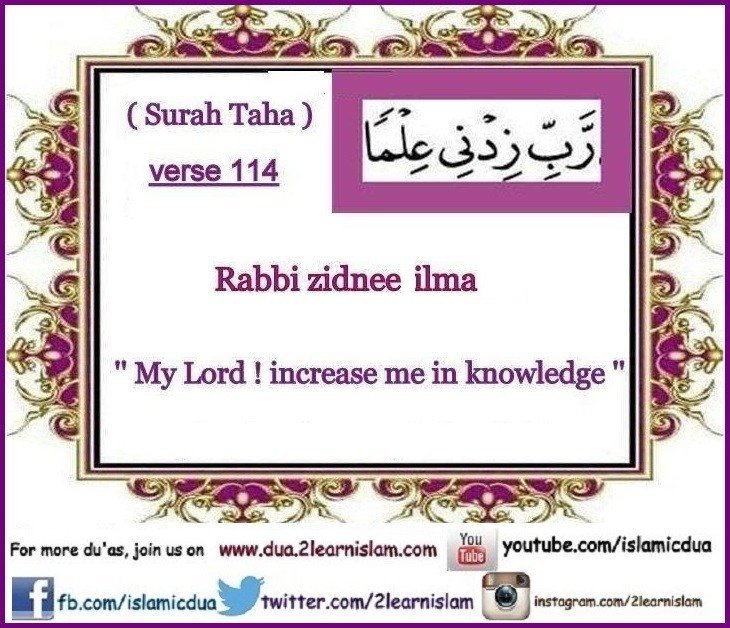
    “My Lord, Increase me in knowledge.”

    رَّبِّ زِدْنِي عِلْمًا

    Rabbi zidnee ‘ilmaa

    Surah Ta-Ha ,verse 114

    It can be recited for

    • Increase in knowledge
    • Wisdom
    • For all types of tests,exams and interviews.


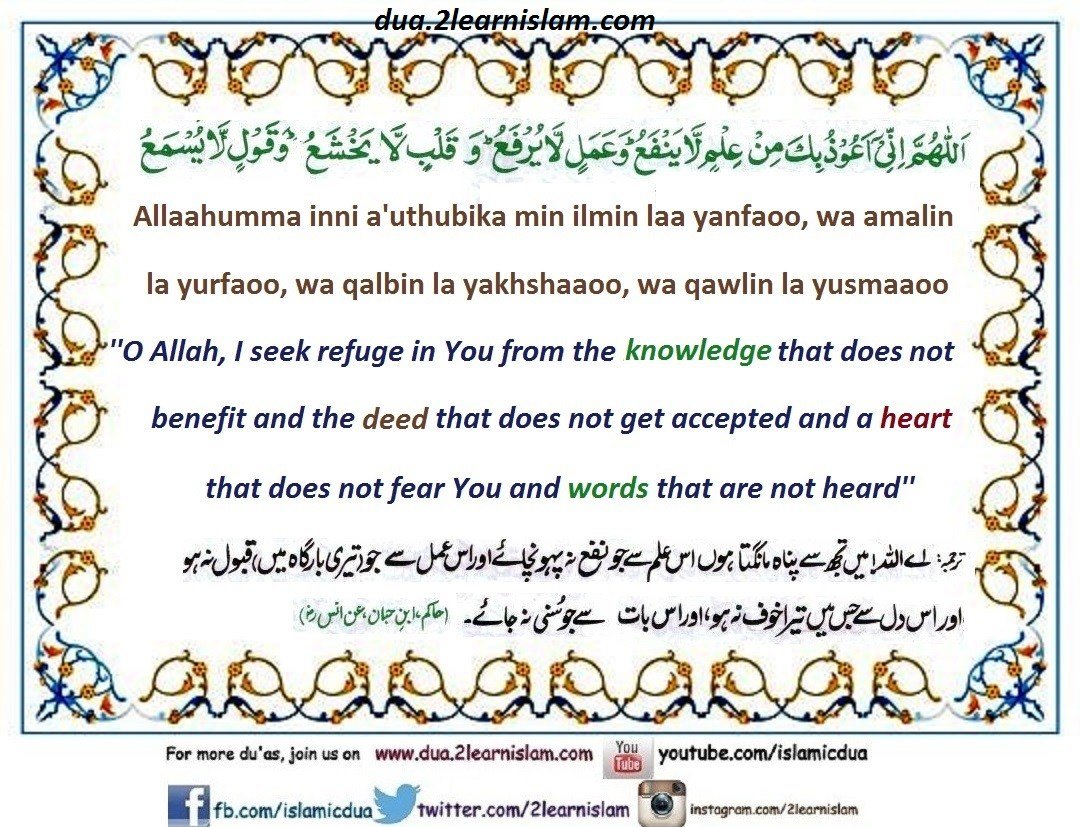
    ”O Allah, I seek refuge in You from KNOWLEDGE THAT DOES NOT BENEFIT and the deed that does not get accepted and a heart that does not fear You and words that are not heard”

    Allaahumma inni a’uthubika min ilmin laa yanfaoo, wa amalin la yurfaoo, wa qalbin la yakhshaaoo, wa qawlin la yusmaaoo

    Hakim, Ibne Habaan, narrated by Ans Radi Allahu anhu


    Click here for the “DUA BOOK” having 120 Beautiful Du’as from the Holy Quran.

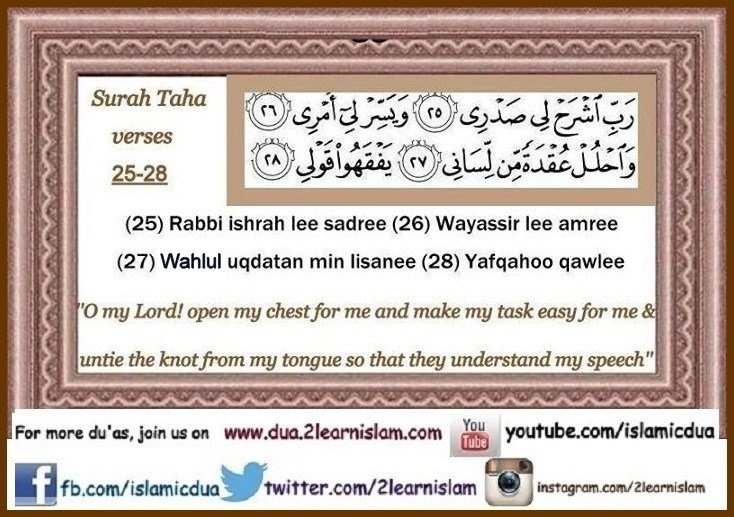
    “My Lord, expand for me my chest (grant me self-confidence, contentment, and boldness) And ease for me my task. And untie the knot from my tongue. That they may understand my speech.

    رَبِّ اشْرَحْ لِي صَدْرِي

    وَيَسِّرْ لِي أَمْرِي

    وَاحْلُلْ عُقْدَةً مِّن لِّسَانِي

    يَفْقَهُوا قَوْلِي

    Rabbi ishrah lee sadree. Wayassir lee amree. Wahlul ‘uqdatan min lisaanee. Yafqahoo qawlee

    Surah Ta-Ha, verses 25-28

     This is the prayer of Prophet Musa Alaihissalaam.

    It can be recited for the following purposes.

    • Success and victory
    • Increase in knowledge
    • Wisdom
    • Cure for stammer
    • To invoke Allah to make all your tasks easier for you
    • To gain confidence
    • For all types of tests,exams and interviews.


    “O Allah, I ask You for KNOWLEDGE that is of benefit, a good PROVISION, and DEEDS that will be accepted”

    اللَّهُمَّ إنِّي أَسْأَلُكَ عِلْماً نَافِعاً، وَرِزقاً طَيِّباً، وَعَمَلاً مُتَقَبَّلاً

    Allaahumma ‘innee ‘as’aluka ‘ilman naafi’an, wa rizqan tayyiban, wa ‘amalan mutaqabbalan.

    Ibn As-Sunni, no. 54, Ibn Majah no. 925. Its chain of transmission is good (Hasan), Ibn Al-Qayyim 2/375.

     Recite in Arabic upon rising in the morning


    “O Allah, there is no ease other than what You make easy. If You please You ease sorrow.”

    للّهُـمَّ لا سَـهْلَ إِلاّ ما جَعَلـتَهُ سَهـلاً، وَأَنْتَ تَجْـعَلُ الْحَـزَنَ إِذا شِـئْتَ سَهـْلاً

    Allaahumma laa sahla ‘illaa maa ja’altahu sahlan wa ‘Anta taj’alul-hazna ‘ithaa shi’ta sahlan

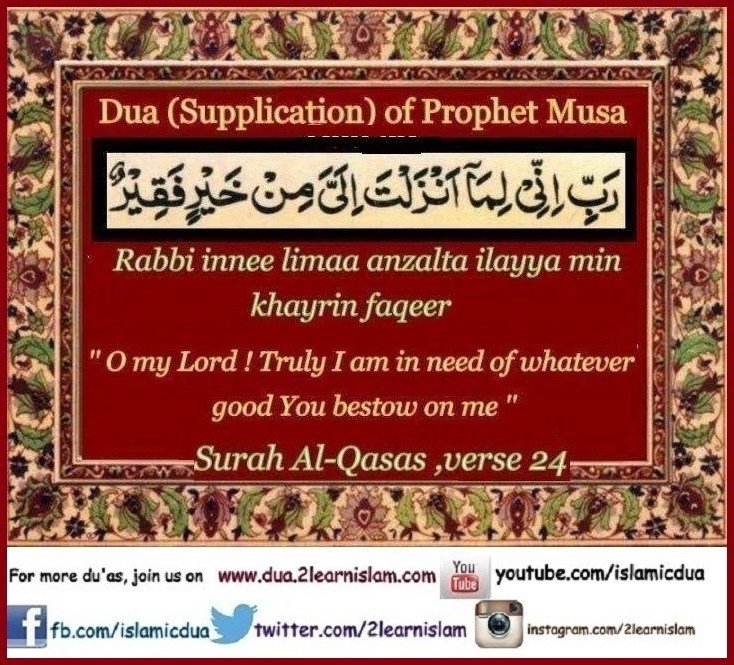
    “My Lord, indeed I am in need of whatever good You would send down to me”

    رَبِّ إِنِّي لِمَآ أَنزَلْتَ إِلَيَّ مِنْ خَيْرٍ فَقِيرٌ

    Rabbi innee limaa anzalta ilayya min khayrin faqeer

    Surah Al-Qasas ,verse 24

    This is the prayer of Prophet Musa Alaihissalaam.

    It can be recited for the following purposes.

    • Success and victory
    • To invoke Allah for His Help and assistance
    • Fulfillment of all types of needs. For example marriage, business, jobs, exams, increase in your sustenance, good health etc
    • For all types of tests,exams and interviews.

    Click here for the “DUA BOOK” having 120 Beautiful Du’as from the Holy Quran.


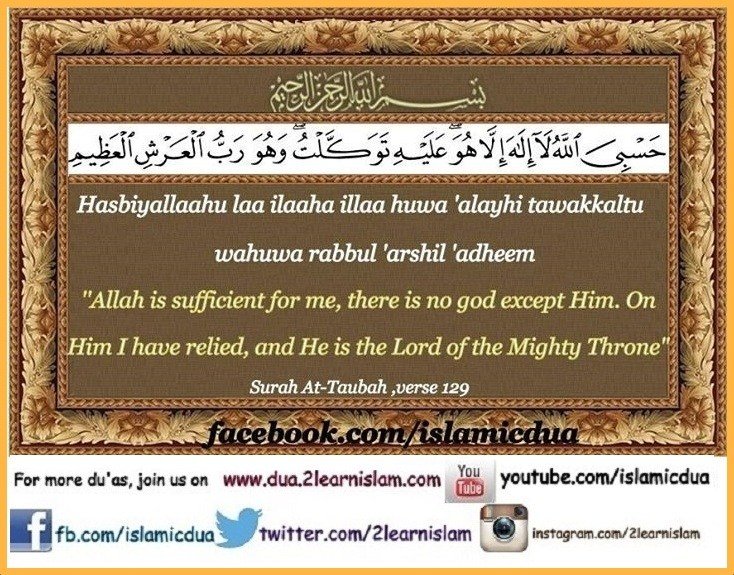
    “Allah is sufficient for me, there is no god except Him. On Him I put my trust, and He is the Lord of the Mighty Throne.”

    حَسْبِىَ اللَّهُ لَآ إِلَـٰهَ إِلَّا هُوَ ۖ عَلَيْهِ تَوَكَّلْتُ ۖ وَهُوَ رَبُّ الْعَرْشِ الْعَظِيمِ

    Hasbiyallaahu laa ilaaha illaa huwa ‘alayhi tawakkaltu wahuwa rabbul ‘arshil ‘adheem

    Surah At-Taubah ,verse 129

    It can be recited for

    • Fulfillment of all types of needs.For example marriage, business, jobs, exams etc
    • To get the best in this world and the next
    • Triumph and success
    • Victory over the disbelievers and the enemies
    • For your protection and safety
    • To seek Allah’s Help in all your matters


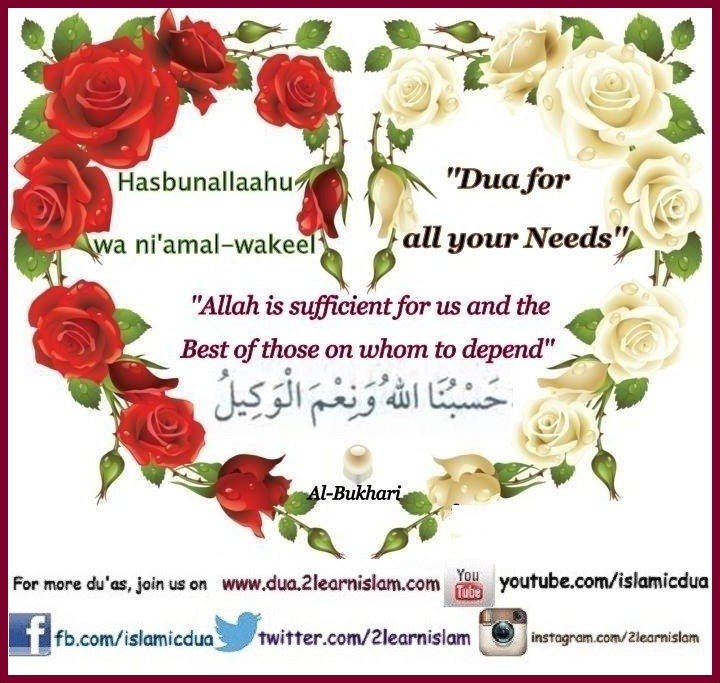
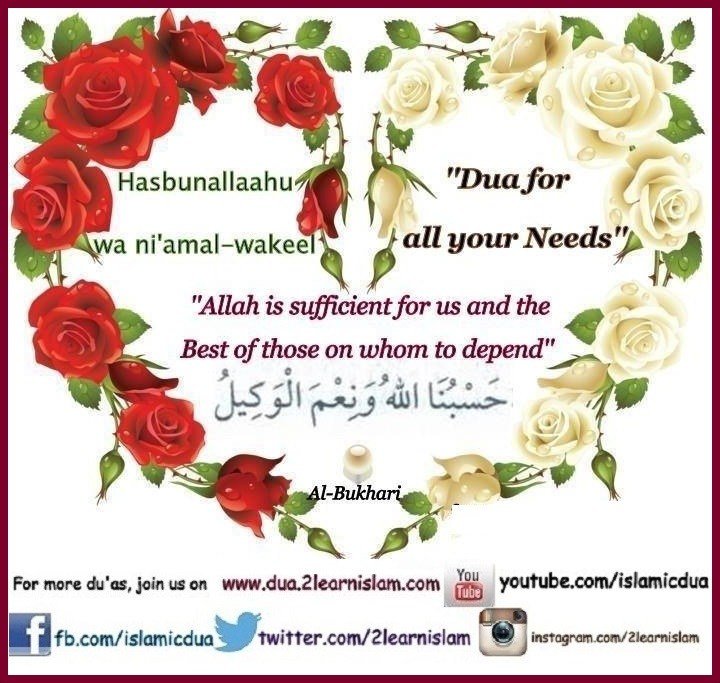
    ”Allah (Alone) is Sufficient for us, and (He is) the Best Disposer of affairs. “

    حَسْبُنَا اللَّهُ وَنِعْمَ الْوَكِيلُ

    Hasbunal-laahu wani’mal-Wakeel

    Surah Al-Imran ,verse 173

    It can be recited

    • Triumph and success
    • Fulfillment of all types of needs. For example marriage, business, jobs, exams, good health
    • To get the best in this world and the next
    • Victory over the disbelievers and the enemies
    • For your protection and safety
    • To seek Allah’s Help in all your matters


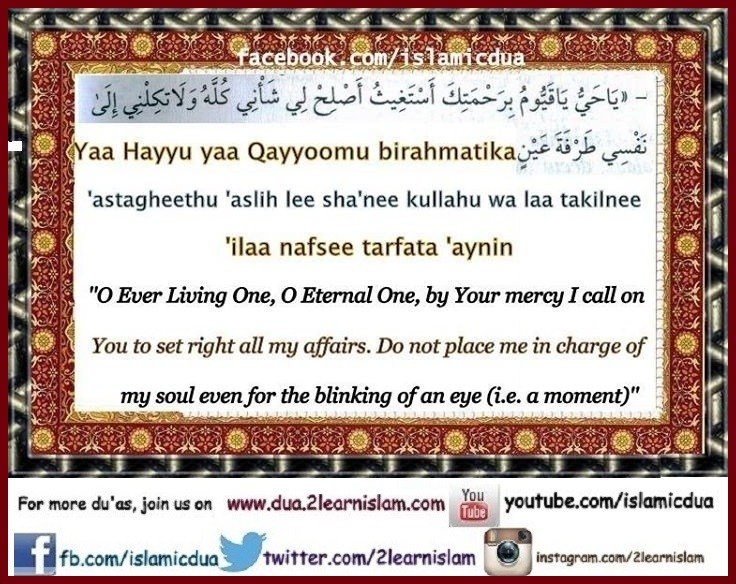
    “O Ever Living One, O Eternal One, by Your mercy, I call on You to set right all my affairs.
     
    Do not place me in charge of my soul even for the blinking of an eye (i.e. a moment)”
     
    يَا حَيُّ يَا قَيُّومُ بِرَحْمَتِكَ أَسْتَغِيثُ أَصْلِحْ لِي شَأْنِي كُلَّهُ وَلَا تَكِلْنِي إِلَى نَفْسِي طَرْفَةَ عَيْنٍ


    Yaa Hayyu yaa Qayyoomu birahmatika ‘astagheethu ‘aslih lee sha’nee kullahu wa laa takilnee ‘ilaa nafsee tarfata ‘aynin.

    Its chain of transmission is sound (Sahih), Al-Hakim 1/545, see Albani


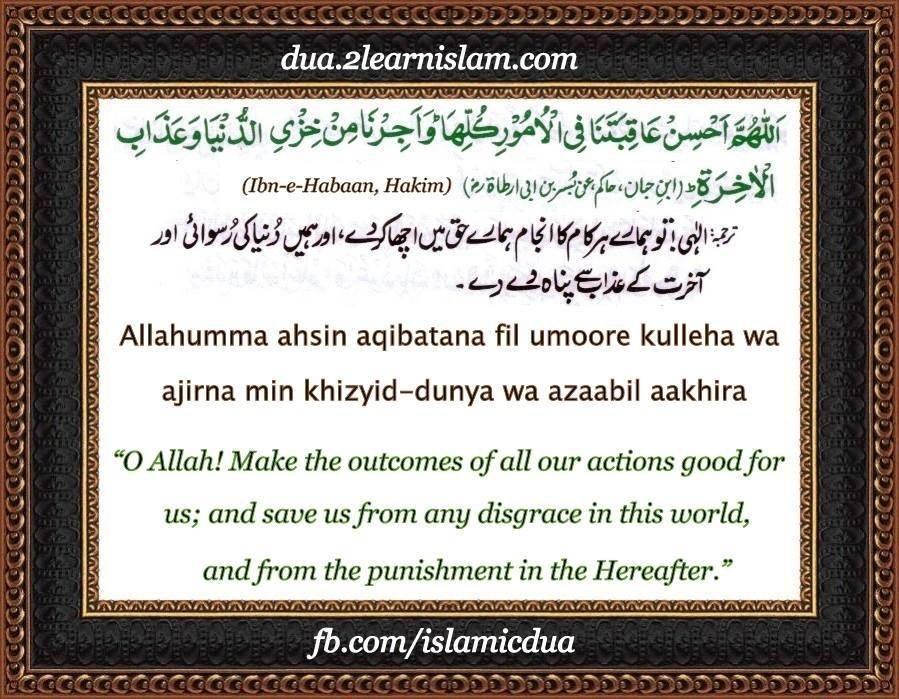
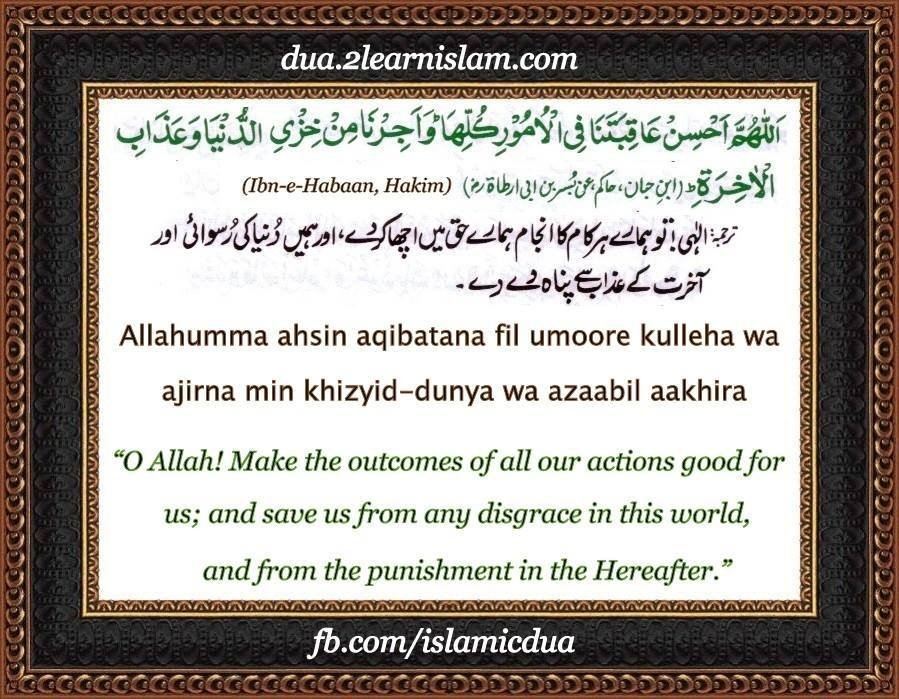
    “O Allah! Make the outcomes of all our actions good for us; and save us from any disgrace in this world, and from the punishment in the Hereafter.”

    أََللّٰهُمَّ أَحْسِنْ عَاقِبَتَنَا فِىْ الْاُ مُوْرِ كُلِّهَا وَأَجِرْنَا مِنْ خِزْىِ الدُّنْيَا وَعَذَابِ الْاٰخِرَةِ
     

    Allahumma ahsin aqibatana fil umoore kulleha wa ajirna min khizyid-dunya wa azaabil aakhira (Ibn e Habaan, Hakim)


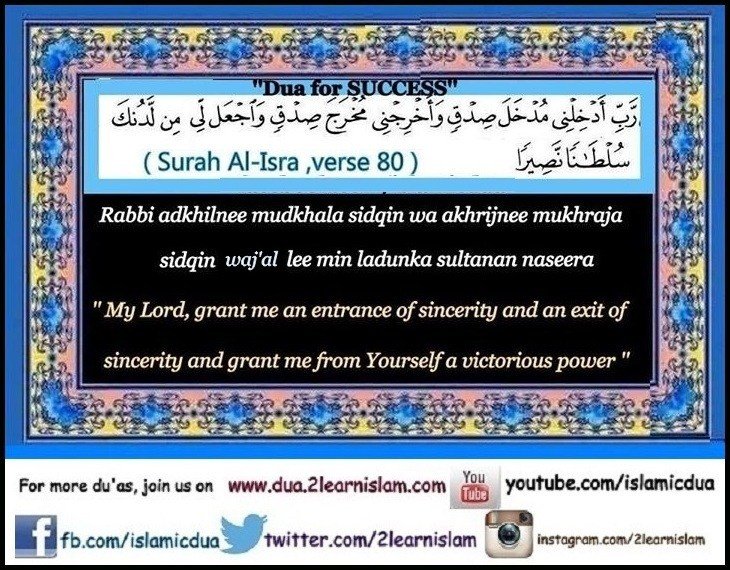
    “My Lord, cause me to enter a sound entrance and cause me to exit a sound exit and And grant me from Yourself an authority to help me”

    رَّبِّ أَدْخِلْنِي مُدْخَلَ صِدْقٍ وَأَخْرِجْنِي مُخْرَجَ صِدْقٍ وَاجْعَل لِّي مِن لَّدُنكَ سُلْطَـٰنًا نَّصِيرًا

    Rabbi adkhilnee mudkhala sidqin waakhrijnee mukhraja sidqin waj’al lee min ladunka sultaanan-naseeraa

    Surah Al-Isra ,verse 80

    This is the prayer of Prophet Mohammad (Peace be upon him)

    This dua can be recited for:-

    • Triumph and success
    • Victory over the disbelievers and the enemies
    • Fulfillment of all types of needs. For example marriage, business, jobs, exams etc
    • To ask for Allah’s Help and Assistance in all your affairs

    One can recite this dua while going for exams,interview, tests, jobs etc.


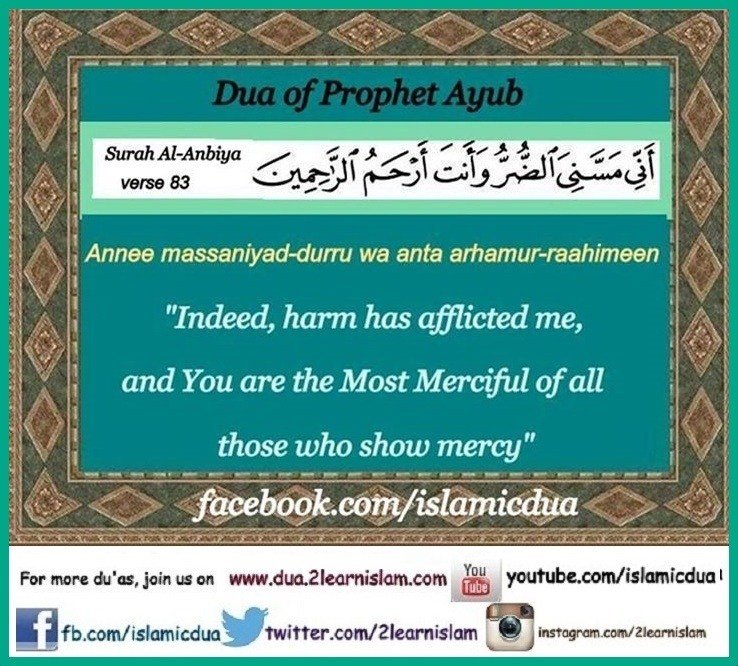
     “Indeed, harm has afflicted me, and You are the Most Merciful of all those who show mercy”

    أَنِّي مَسَّنِيَ الضُّرُّ وَأَنتَ أَرْحَمُ الرَّاحِمِينَ

    Annee massaniyaddurru wa-anta arhamur-raahimeen

    Surah Al-Anbiya ,verse 83

    This is the prayer of Prophet Ayub Alaihissalaam.

    This dua can be recited :-

    • When you are overtaken by adversity and distress.
    • Good health and the cure of all the diseases
    • Removal of affliction and calamities
    • Fulfillment of all types of needs. For example marriage, business, jobs, exams etc


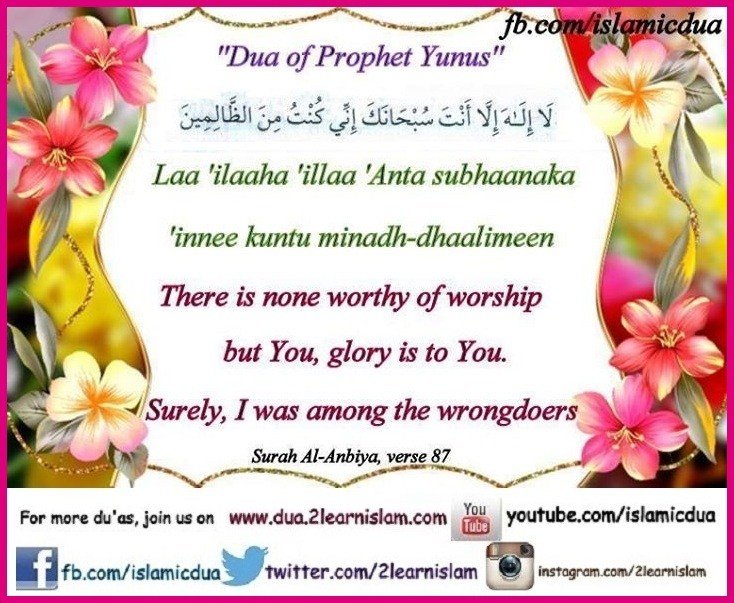
     “There is no god except You; Glory be to You! Indeed, I have been of the wrongdoers.”

    لَّا إِلَٰهَ إِلَّا أَنتَ سُبْحَانَكَ إِنِّي كُنتُ مِنَ ٱلظَّـٰلِمِينَ َ

    Laa ilaaha illaa anta subhaanaka innee kuntu minadhdhaalimeen.

    Surah Al- Anbiya, verse 87

    This is the prayer of Prophet Yunus Alaihissalaam.

    It can be recited for

    • Forgiveness of your sins
    • Removal of affliction and calamities
    • Good health and the cure of all the diseases
    • Fulfillment of all types of needs.For example marriage, business, jobs, exams etc

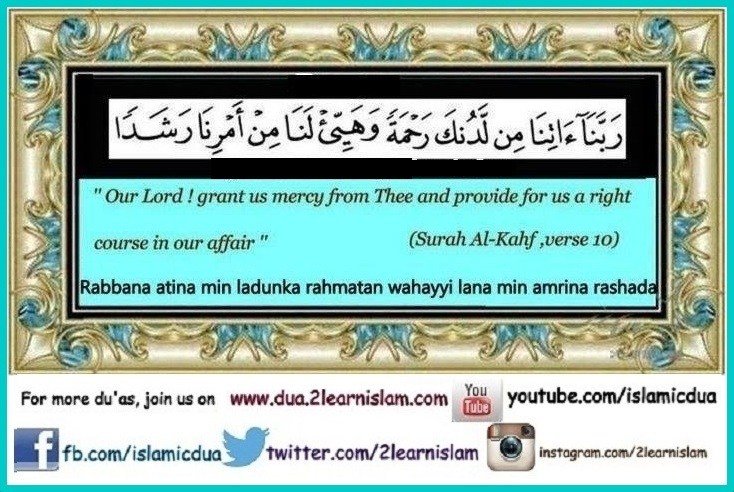
    “Our Lord! Grant us mercy from Yourself, and facilitate for us our affair in the right way!”

    رَبَّنَا آتِنَا مِن لَّدُنكَ رَحْمَةً وَهَيِّئْ لَنَا مِنْ أَمْرِنَا رَشَدًا

    Rabbanaa aatinaa min ladunka rahmatan wahayyi lanaa min amrinaa rashadaa

    Surah Al-Kahf, verse 10

    It can be recited for

    • Success in all your affairs
    • Fulfillment of all types of needs. For example marriage, business, jobs, exams etc
    • To gain Allah’s Mercy
    • To invoke Allah to ease all your tasks for you
    • For all types of tests,exams and interviews.

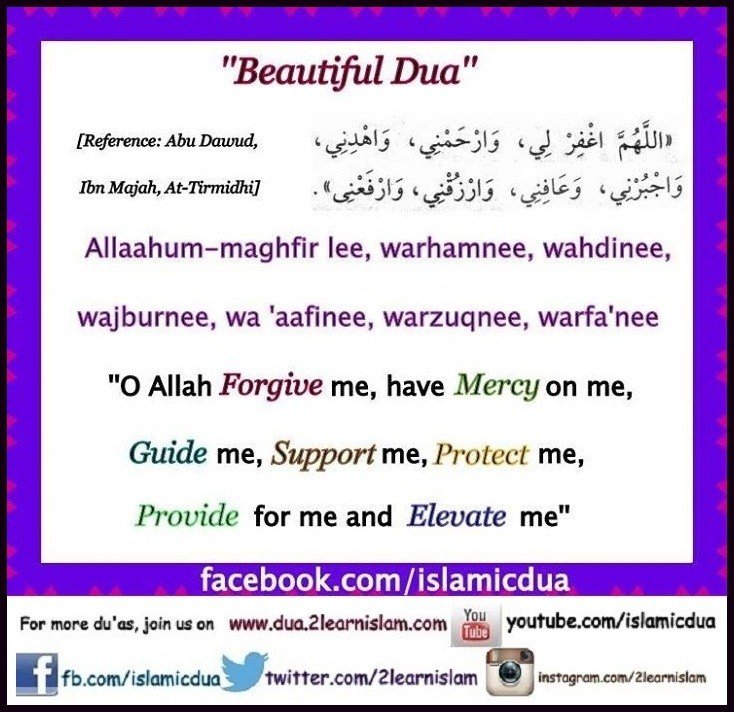
    “O Allah FORGIVE me, have MERCY on me,GUIDE me, SUPPORT me, PROTECT me, PROVIDE for me
    and ELEVATE me”
     
    اللَّهُمَّ اغْفِرْ لِي، وَارْحَمْنِي، وَاهْدِنِي، وَاجْبُرْنِي، وَعَافِنِي، وَارْزُقْنِي، وَارْفَعْنِي

    Allaahum-maghfir lee, warhamnee, wahdinee, wajburnee, wa ‘aafinee, warzuqnee, warfa’nee


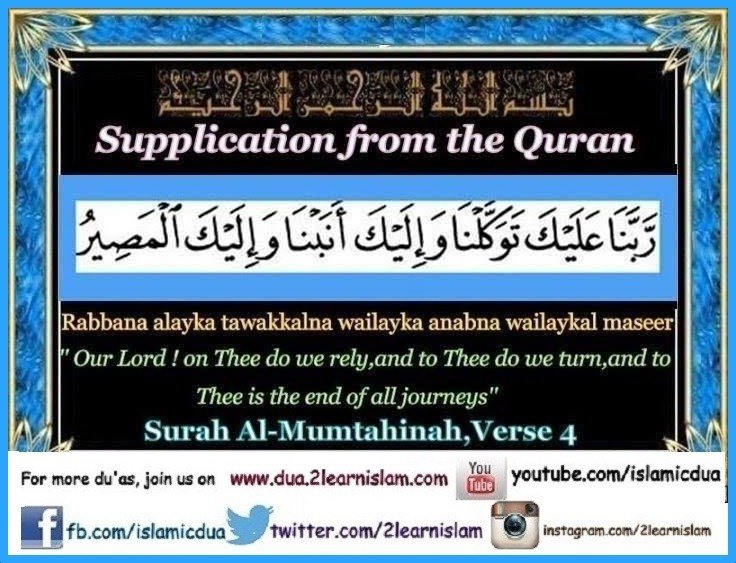
    “Our Lord, upon You we put our trust, and to You we turn, and to You is the final return”

    رَّبَّنَا عَلَيْكَ تَوَكَّلْنَا وَإِلَيْكَ أَنَبْنَا وَإِلَيْكَ الْمَصِيرُ

    Rabbanaa ‘alayka tawakkalnaa wa-ilayka anabnaa wa ilaykal-maseer

    Surah Al-Mumtahinah ,verse 4

    This dua can be recited for

    • Success and victory
    • To invoke Allah for His Help and assistance
    • Fulfilment of all types of needs. For example marriage, business, jobs, exams etc
    • For all types of tests,exams and interviews.

    This the supplication of Prophet Ibrahim Alaihissalaam and his followers.


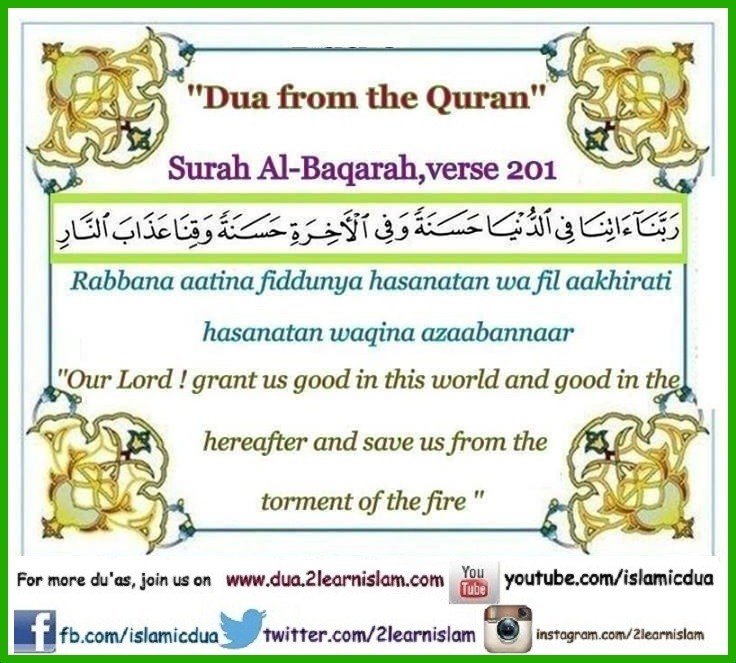
    ” Our Lord ! Grant us good in this world and good in the hereafter and Save us from the punishment of the Fire ”

    رَبَّنَا آتِنَا فِي الدُّنْيَا حَسَنَةً وَفِي الْآخِرَةِ حَسَنَةً وَقِنَا عَذَابَ النَّارِ

    Rabbanaa aatinaa fid-dunyaa hasanatan wafil-aakhirati hasanatan waqinaa ‘athaaban-naar

    Surah Al-Baqarah ,verse 201

    It can be recited for

    • Success

    • Fulfilment of all types of needs. For example marriage, business, jobs, exams etc

    • Protection from the torment of the Fire

    • To get the best in this world and the next

  • Duas for increase in your income, wealth & sustenance

    Duas for increase in your income, wealth & sustenance

    Dua for increase in income, wealth and to repay your debts and loans

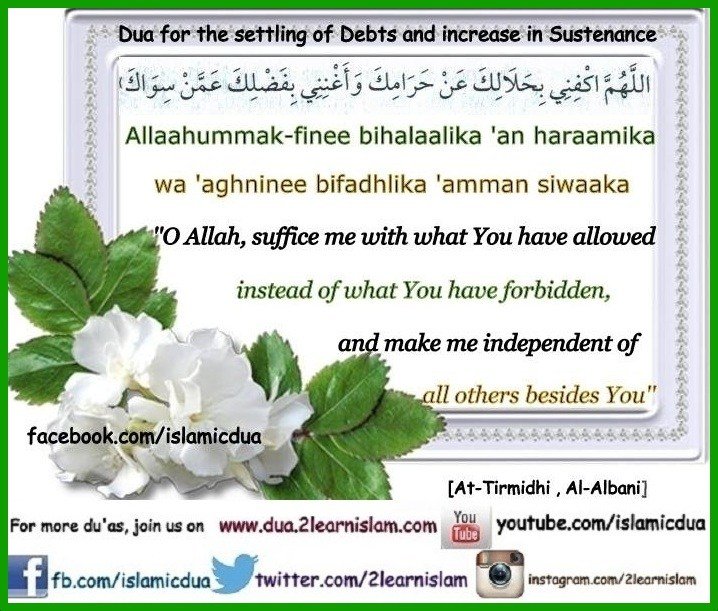
    “O Allah, suffice me with what You have allowed instead of what You have forbidden, and make me independent of all others besides You.”

     اللّهُـمَّ اكْفِـني بِحَلالِـكَ عَنْ حَـرامِـك، وَأَغْنِـني بِفَضْـلِكِ عَمَّـنْ سِـواك

    Allaahummak-finee bihalaalika ‘an haraamika wa ‘aghninee bifadhlika ‘amman siwaaka

    Click here for the “DUA BOOK” having 120 Beautiful Du’as from the Holy Quran.


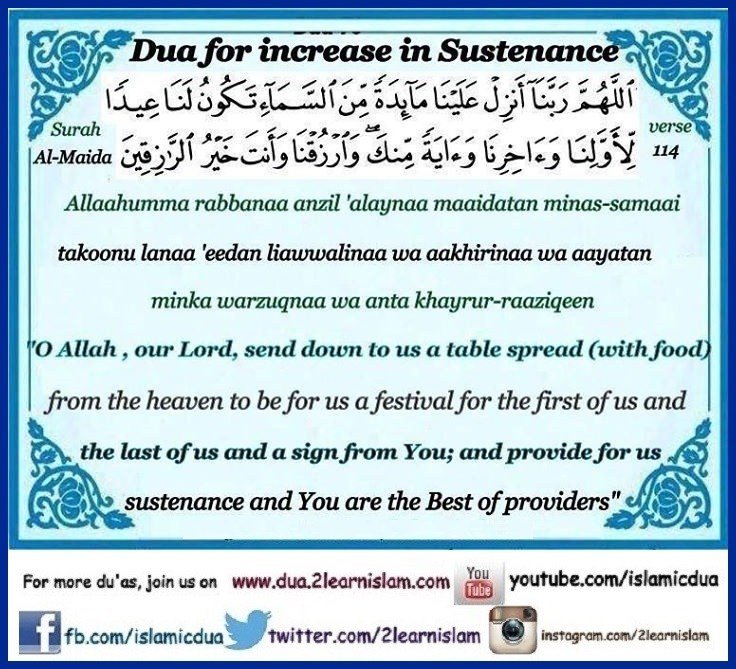
    “O Allah , our Lord, send down to us a table spread (with food) from the heaven to be for us a festival for the first of us and the last of us and a sign from You; and provide for us sustenance,and You are the Best of providers.”

    اللَّهُمَّ رَبَّنَا أَنزِلْ عَلَيْنَا مَآئِدَةً مِّنَ ٱلسَّمَآءِ تَكُونُ لَنَا عِيدًا لِّأَوَّلِنَا وَآخِرِنَا وَآيَةً مِّنكَ ۖ وَارْزُقْنَا وَأَنتَ خَيْرُ الرَّازِقِينَ

    Allaahumma rabbanaa anzil ‘alaynaa maaidatan minas-samaai takoonu lanaa ‘eedan li-awwalinaa wa aakhirinaa wa aayatan minka warzuqnaa wa anta khayrur-raaziqeen

    Surah Al-Maida ,verse 114

    This is the prayer of Prophet Isa Alaihissalaam

    It can be recited for the following purposes.

    • Increase in your sustenance
    • To invoke Allah for His help and provision

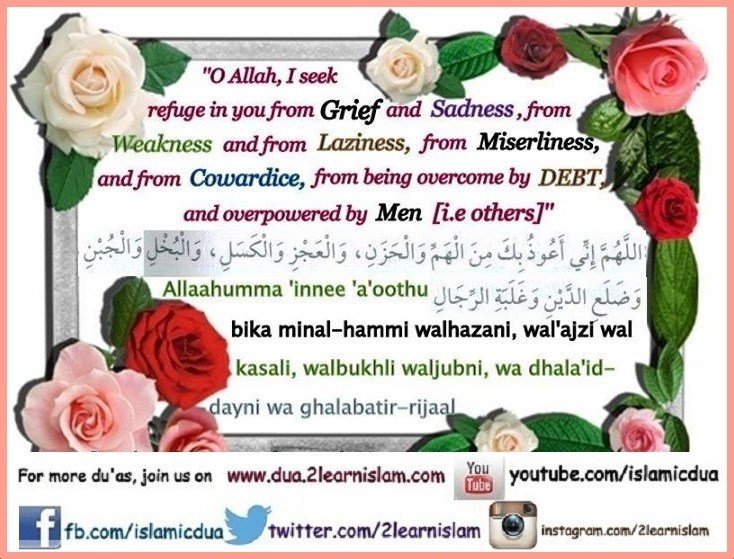
    O Allah, I seek refuge in you from grief and sadness, from weakness and from laziness, from miserliness and from cowardice, from being overcome by debt and overpowered by men (i.e. others).

    اللّهُـمَّ إِنِّي أَعْوذُ بِكَ مِنَ الهَـمِّ وَ الْحُـزْنِ، والعًجْـزِ والكَسَلِ والبُخْـلِ والجُـبْنِ، وضَلْـعِ الـدَّيْنِ وغَلَبَـةِ الرِّجال

    Allaahumma ‘innee ‘a’oothu bika minal-hammi walhazani, wal’ajzi walkasali, walbukhli waljubni, wa dhala’id-dayni wa ghalabatir-rijaal

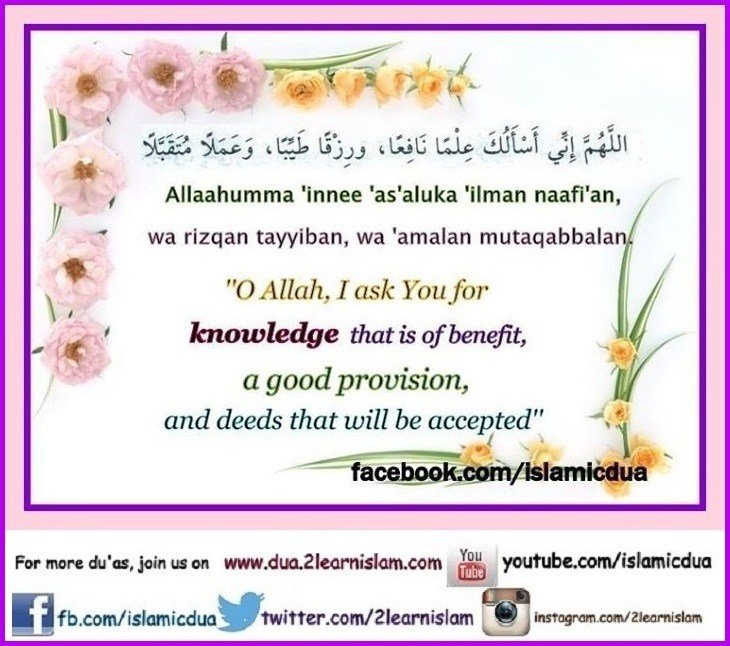
    “O Allah, I ask You for KNOWLEDGE that is of benefit, a good PROVISION, and DEEDS that will be accepted”

    اللَّهُمَّ إنِّي أَسْأَلُكَ عِلْماً نَافِعاً، وَرِزقاً طَيِّباً، وَعَمَلاً مُتَقَبَّلاً

    Allaahumma ‘innee ‘as’aluka ‘ilman naafi’an, wa rizqan tayyiban, wa ‘amalan mutaqabbalan.

    Ibn As-Sunni, no. 54, Ibn Majah no. 925. Its chain of transmission is good (Hasan), Ibn Al-Qayyim 2/375.

     Recite in Arabic upon rising in the morning


    “My Lord, indeed I am in need of whatever good You would send down to me”

    رَبِّ إِنِّي لِمَآ أَنزَلْتَ إِلَيَّ مِنْ خَيْرٍ فَقِيرٌ

    Rabbi innee limaa anzalta ilayya min khayrin faqeer

    Surah Al-Qasas ,verse 24

    This is the prayer of Prophet Musa Alaihissalaam.

    It can be recited for the following purposes.

    • Success and victory
    • To invoke Allah for His Help and assistance
    • Fulfillment of all types of needs. For example marriage, business, jobs, exams, increase in your sustenance, good health etc
    • For all types of tests,exams and interviews.

    Click here for the “DUA BOOK” having 120 Beautiful Du’as from the Holy Quran.

    “O Allah, there is no ease other than what You make easy. If You please You ease sorrow.”

    للّهُـمَّ لا سَـهْلَ إِلاّ ما جَعَلـتَهُ سَهـلاً، وَأَنْتَ تَجْـعَلُ الْحَـزَنَ إِذا شِـئْتَ سَهـْلاً

    Allaahumma laa sahla ‘illaa maa ja’altahu sahlan wa ‘Anta taj’alul-hazna ‘ithaa shi’ta sahlan

    “Allah is sufficient for me, there is no god except Him. On Him I put my trust, and He is the Lord of the Mighty Throne.”

    حَسْبِىَ اللَّهُ لَآ إِلَـٰهَ إِلَّا هُوَ ۖ عَلَيْهِ تَوَكَّلْتُ ۖ وَهُوَ رَبُّ الْعَرْشِ الْعَظِيمِ

    Hasbiyallaahu laa ilaaha illaa huwa ‘alayhi tawakkaltu wahuwa rabbul ‘arshil ‘adheem

    Surah At-Taubah ,verse 129

    It can be recited for

    • Fulfillment of all types of needs.For example marriage, business, jobs, exams etc
    • To get the best in this world and the next
    • Triumph and success
    • Victory over the disbelievers and the enemies
    • For your protection and safety
    • To seek Allah’s Help in all your matters


    ”Allah (Alone) is Sufficient for us, and (He is) the Best Disposer of affairs. “

    حَسْبُنَا اللَّهُ وَنِعْمَ الْوَكِيلُ

    Hasbunal-laahu wani’mal-Wakeel

    Surah Al-Imran ,verse 173

    It can be recited

    • Triumph and success
    • Fulfillment of all types of needs. For example marriage, business, jobs, exams, good health
    • To get the best in this world and the next
    • Victory over the disbelievers and the enemies
    • For your protection and safety
    • To seek Allah’s Help in all your matters


    “O Ever Living One, O Eternal One, by Your mercy, I call on You to set right all my affairs.
     
    Do not place me in charge of my soul even for the blinking of an eye (i.e. a moment)”
     
    يَا حَيُّ يَا قَيُّومُ بِرَحْمَتِكَ أَسْتَغِيثُ أَصْلِحْ لِي شَأْنِي كُلَّهُ وَلَا تَكِلْنِي إِلَى نَفْسِي طَرْفَةَ عَيْنٍ


    Yaa Hayyu yaa Qayyoomu birahmatika ‘astagheethu ‘aslih lee sha’nee kullahu wa laa takilnee ‘ilaa nafsee tarfata ‘aynin.

    Its chain of transmission is sound (Sahih), Al-Hakim 1/545, see Albani


    “O Allah! Make the outcomes of all our actions good for us; and save us from any disgrace in this world, and from the punishment in the Hereafter.”

    أََللّٰهُمَّ أَحْسِنْ عَاقِبَتَنَا فِىْ الْاُ مُوْرِ كُلِّهَا وَأَجِرْنَا مِنْ خِزْىِ الدُّنْيَا وَعَذَابِ الْاٰخِرَةِ
     

    Allahumma ahsin aqibatana fil umoore kulleha wa ajirna min khizyid-dunya wa azaabil aakhira (Ibn e Habaan, Hakim)

    “My Lord, cause me to enter a sound entrance and cause me to exit a sound exit and And grant me from Yourself an authority to help me”

    رَّبِّ أَدْخِلْنِي مُدْخَلَ صِدْقٍ وَأَخْرِجْنِي مُخْرَجَ صِدْقٍ وَاجْعَل لِّي مِن لَّدُنكَ سُلْطَـٰنًا نَّصِيرًا

    Rabbi adkhilnee mudkhala sidqin waakhrijnee mukhraja sidqin waj’al lee min ladunka sultaanan-naseeraa

    Surah Al-Isra ,verse 80

    This is the prayer of Prophet Mohammad (Peace be upon him)

    This dua can be recited for:-

    • Triumph and success
    • Victory over the disbelievers and the enemies
    • Fulfillment of all types of needs. For example marriage, business, jobs, exams etc
    • To ask for Allah’s Help and Assistance in all your affairs

    One can recite this dua while going for exams,interview, tests, jobs etc.


     “Indeed, harm has afflicted me, and You are the Most Merciful of all those who show mercy”

    أَنِّي مَسَّنِيَ الضُّرُّ وَأَنتَ أَرْحَمُ الرَّاحِمِينَ

    Annee massaniyaddurru wa-anta arhamur-raahimeen

    Surah Al-Anbiya ,verse 83

    This is the prayer of Prophet Ayub Alaihissalaam.

    This dua can be recited :-

    • When you are overtaken by adversity and distress.
    • Good health and the cure of all the diseases
    • Removal of affliction and calamities
    • Fulfillment of all types of needs. For example marriage, business, jobs, exams etc


     “There is no god except You; Glory be to You! Indeed, I have been of the wrongdoers.”

    لَّا إِلَٰهَ إِلَّا أَنتَ سُبْحَانَكَ إِنِّي كُنتُ مِنَ ٱلظَّـٰلِمِينَ َ

    Laa ilaaha illaa anta subhaanaka innee kuntu minadhdhaalimeen.

    Surah Al- Anbiya, verse 87

    This is the prayer of Prophet Yunus Alaihissalaam.

    It can be recited for

    • Forgiveness of your sins
    • Removal of affliction and calamities
    • Good health and the cure of all the diseases
    • Fulfillment of all types of needs.For example marriage, business, jobs, exams etc


    “Our Lord! Grant us mercy from Yourself, and facilitate for us our affair in the right way!”

    رَبَّنَا آتِنَا مِن لَّدُنكَ رَحْمَةً وَهَيِّئْ لَنَا مِنْ أَمْرِنَا رَشَدًا

    Rabbanaa aatinaa min ladunka rahmatan wahayyi lanaa min amrinaa rashadaa

    Surah Al-Kahf, verse 10

    It can be recited for

    • Success in all your affairs
    • Fulfillment of all types of needs. For example marriage, business, jobs, exams etc
    • To gain Allah’s Mercy
    • To invoke Allah to ease all your tasks for you
    • For all types of tests,exams and interviews.


    “O Allah FORGIVE me, have MERCY on me,GUIDE me, SUPPORT me, PROTECT me, PROVIDE for me
    and ELEVATE me”
     
    اللَّهُمَّ اغْفِرْ لِي، وَارْحَمْنِي، وَاهْدِنِي، وَاجْبُرْنِي، وَعَافِنِي، وَارْزُقْنِي، وَارْفَعْنِي

    Allaahum-maghfir lee, warhamnee, wahdinee, wajburnee, wa ‘aafinee, warzuqnee, warfa’nee


    “Our Lord, upon You we put our trust, and to You we turn, and to You is the final return”

    رَّبَّنَا عَلَيْكَ تَوَكَّلْنَا وَإِلَيْكَ أَنَبْنَا وَإِلَيْكَ الْمَصِيرُ

    Rabbanaa ‘alayka tawakkalnaa wa-ilayka anabnaa wa ilaykal-maseer

    Surah Al-Mumtahinah ,verse 4

    This dua can be recited for

    • Success and victory
    • To invoke Allah for His Help and assistance
    • Fulfilment of all types of needs. For example marriage, business, jobs, exams etc
    • For all types of tests,exams and interviews.

    This the supplication of Prophet Ibrahim Alaihissalaam and his followers.


    ” Our Lord ! Grant us good in this world and good in the hereafter and Save us from the punishment of the Fire ”

    رَبَّنَا آتِنَا فِي الدُّنْيَا حَسَنَةً وَفِي الْآخِرَةِ حَسَنَةً وَقِنَا عَذَابَ النَّارِ

    Rabbanaa aatinaa fid-dunyaa hasanatan wafil-aakhirati hasanatan waqinaa ‘athaaban-naar

    Surah Al-Baqarah ,verse 201

    It can be recited for

    • Success

    • Fulfilment of all types of needs. For example marriage, business, jobs, exams etc

    • Protection from the torment of the Fire

    • To get the best in this world and the next