Tag: makkah

  • Merits of Surah Al-Fatah

    Merits of Surah Al-Fatah

    The Merit of Surah Al-Fatah

    Imam Ahmad recorded from `Abdullah bin Mughaffal, who said that Allah’s Messenger recited Surah Al-Fath on the (day) of the conquest of Makkah, riding on his she-camel. He recited it in a vibrating and pleasant tone. Mu`awiyah (a subnarrator) added: “Were I not afraid that the people would crowd around me, I would surely try to imitate and produce his recitation.” Both Al-Bukhari and Muslim recorded this Hadith through Shu`bah.

    The Reason behind revealing Surat Al-Fatah

    This honorable Surah was revealed after the Messenger of Allah returned from the area of Al-Hudaybiyyah, during the month of Dhul-Qa`dah, in the sixth year of Hijrah. This is when the idolators prevented him from reaching Al-Masjid Al-Haram to perform the `Umrah he intended. They stopped the Prophet from reaching Makkah at that time, but then were prone to peace negotiations. A peace treaty was conducted stipulating that the Messenger would return this year and then come back for `Umrah the following year. The Messenger agreed. However, some of the Companions disliked these terms, including `Umar bin Al-Khattab.

    After the Prophet slaughtered his sacrificial animals in the area where he was stopped and headed back to Al-Madinah, Allah the Exalted and Most Honored revealed this Surah about what occurred between him and the idolators. Allah declared the Al-Hudaybiyyah peace treaty a manifest victory, because of the benefits peace would carry and the good results that did originate from it. `Abdullah bin Mas`ud and other Companions said, “You consider the conquering of Makkah to be Al-Fath (the victory), while to us, Al-Fath is the treaty conducted at Al-Hلudaybiyyah.” Jabir (bin `Abdullah) said, “We only considered Al-Fath to be the day of Hلudaybiyyah!”

    Al-Bukhari recorded that Al-Bara’ (bin `Azib) said, “You consider Al-Fath to be the conquest of Makkah, which was indeed a victory. However, we consider Al-Fath to be the pledge of Ar-Ridwan on the Day of Al-Hudaybiyyah. Then, we were fourteen hundred with the Messenger of Allah .

    Al-Hudaybiyyah had a well, whose water we consumed, not leaving a drop of water in it. When the news of what happened reached the Messenger of Allah , he came towards us and sat on the edge of the well. Then he asked to be brought a bucket of water and used it for ablution. He next rinsed his mouth, invoked Allah and poured that water into the well. Soon after, that well provided us, as well as our animals, with sufficient water, in whatever amount of water we wished.

    Imam Ahmad recorded that `Umar bin Al-Khattab said, “We were with the Messenger of Allah on a trip, and I asked him about a matter three times, but he did not answer me. So I said to myself, `May your mother lose you, O son of Al-Khattab! You were stubborn in repeating your question three times to the Messenger of Allah ; each time he did not respond to you.’ So I mounted my animal, my camel, and went ahead for fear that a part of the Qur’an might be revealed in my case. Suddenly, I heard a caller calling, `O `Umar!’ So, I went to the Messenger while fearing that part of the Qur’an was revealed about me. The Prophet said,

    (Last night, a Surah was revealed to me that is dearer to me than this life and all that it contains: (Verily, We have given you a manifest victory. That Allah may forgive you your sins of the past and the future.))

    Al-Bukhari, At-Tirmidhi and An-Nasa’i collected this Hadith from several chains of narration through Malik, may Allah grant him His mercy. `Ali bin Al-Madini commented, “This is a good chain of narration consisting of the scholars of Al-Madinah.”

    Imam Ahmad recorded that Anas bin Malik said, “This Ayah was revealed to the Prophet ,

    (That Allah may forgive you your sins of the past and the future,) on his return from Al-Hudaybiyyah. The Prophet said,

    (Tonight, an Ayah, that is dearer to me than all that the earth carries, was revealed to me.) The Prophet recited the Ayah to them. They said, `Congratulations, O Allah’s Messenger! Allah the Exalted and Most Honored has stated what He will do with you. So what will He do with us

    Allah’s statement,

    (Verily, We have given you a manifest victory.) means, clear and apparent victory. This Ayah is about the treaty at Al-Hudaybiyyah, which resulted in great goodness, including people embracing Islam in large crowds and having the chance to meet each other

  • The Prophet’s role In The Rebuilding Of The Ka’bah

    The Prophet’s role In The Rebuilding Of The Ka’bah

    The Important Role That The Prophet (Peace be upon him)
    Played In The Rebuilding Of The Ka’bah”

    When the Prophet (Peace be upon him) was 35 years old, which was about five
    years before he received revelation for the first time, Quraish’s
    chieftains gathered to discuss an important matter: the rebuilding
    of the Ka’bah. Due to flood waters and other causes, the walls of
    the Ka’bah began to split; the damage was so severe that the
    Quraish feared that the edifice of the Ka’bah would simply
    collapse at any time.

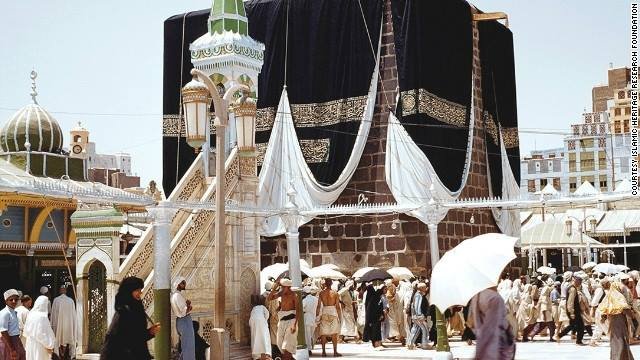
    The Ka’bah was still upon the construction of Ibraaheem Alaihissalaam, it was
    slightly higher than the height of the average man, and it consisted
    of stones stacked up one on top of another, without any clay to hold
    them together. What the Quraish wanted to do was not a simple
    renovation; rather, they wanted to first destroy the edifice of the
    Ka’bah and then rebuild it with a roof. But they were afraid, feeling
    that doing so might be a form of sacrilege that would lead to evil
    repercussions.

    Al-Waleed ibn Al-Mugheerah, chief of the
    Makhzoom clan, said to the others, “I will begin with its
    destruction’ He picked up an axe, stood beside the Ka’bah, and
    said, “O Allah, we have not gone astray, and we want only that
    which is good.”

    In the end, they decided to begin by demolishing only a part of the
    Ka’bah, and then to wait one night. If, during the night, they saw
    an evil portent, they would stop destroying the Ka’bah and fix the
    part they had already destroyed. But if, during the night, they saw
    no warning sign, they would continue with the demolition and
    reconstruction of the Ka’bah. Since nothing happened
    that night, they did the latter.

    Each subtribe was assigned the task of working on one side of the
    Ka’bah. And though the work involved physical labor that was
    normally performed by the lower classes, the chieftains and
    noblemen participated as well, since the work was considered
    sacred in nature. And so Makkan chieftains would pick up stones
    and raise them up onto the new structure of the Ka’bah.

    When the reconstruction project was almost completed, a heated
    argument broke out. The only step that remained in the
    reconstruction was to place the Black Stone in its place; the
    problem was that every chieftain wanted the honour of picking
    up the Black Stone and placing it in the corner of the Ka’bah.

    Makkah’s oldest chieftain, Umayyah ibn Al-Mugheerah,
    said, “O people of Quraish, concerning that over which you
    differ, appoint the first person to enter the door of the Masjid to
    act as judge over you’

    After they agreed to follow Umayyah’s
    suggestion, they all anxiously waited to see who it was that was
    going to enter the door. To their mutual satisfaction, it was
    Muhammad(Peace be upon him) ibn ‘Abdullah and upon seeing him, they all
    exclaimed, “Here is the Trustworthy One. We are indeed pleased’

    After they told him about their dispute, the Prophet(Peace be upon him) said, “Bring
    me a robe.” When they brought one to him, he placed the Black
    Stone in its middle with his hands and said, “Let each tribe (i.e.,
    subtribe) hold one corner of the robe’ So the leader of each
    subtribe held one corner of the robe; then, together, they raised it
    and carried it to its place, at which point the Prophet (Peace be upon him) removed it
    from the robe and put it in its proper place. Everyone was satisfied,
    and war was averted.

    The reconstruction effort was a success. The Ka’bah was now 18
    arm-spans high, and six wooden columns were used to hold up
    the roof. The door of the Ka’bah was elevated slightly above
    ground level; stairs were constructed between the ground and
    the door to permit entry.

    Morals and Lessons

    1) The way in which the Prophet(Peace be upon him) brought an end to the dispute
    was both wise and just.What was so wonderful
    about the Prophet’s solution was that he was able to satisfy
    the members of all subtribes; this was an example of how Allah guided the Prophet (Peace be upon him) to make wise and correct decisions
    even before the period of Prophethood. Allah decreed for the
    Prophet to enter the As-Safaa door, in order to resolve the
    difficult crisis that was brewing.

    2) The events that took place during Quraish’ s rebuilding of the
    Ka’bah underscore two important points: First, the Prophet’s
    high status and ranking among the Quraish. And second,
    Quraish’ s self -contradictory attitude after the Prophet (Peace be upon him)
    declared his Prophethood, for they were calling him a liar,
    when only a few years earlier they had all declared that he was
    the “Truthful, Trustworthy One’

    3) The Prophet(Peace be upon him) gained two important honours during the
    rebuilding of the Ka’bah: First, the honour of preventing
    bloodshed between Quraish’ s subtribes. And second, he
    had the honour of doing what the Quraish were competing for,
    namely, the honour of placing the Black Stone in its place.

    After you finish reading this, don’t forget to send durood on our Holy Prophet Mohammad Sallal laahoo alaihi wassallam and share this knowledge with your friends and family.

    Click here to read and download the pic of Durood-e-Paak (to send peace and blessings on our HOLY PROPHET (PEACE BE UPON HIM)