Category: Islamic Reminders

  • The Reasons Which Cause Love of Allāh


    The reasons which cause love of Allāh to develop, are TEN:

    First : Reciting the Qur‘ân, reflecting and understanding its meaning and its intent.

    Second: Drawing closer to Allāh – the Most High – through optional deeds, after fulfilling the obligatory duties.

    Third: Being continuous in the dhikr (remembrance) of Allāh, with the tongue, the heart and the limbs – under all circumstances. The more constant the dhikr, the more mahabbah develops and intensifies.

    Fourth: Giving precedence to what Allāh loves over personal loves, when being overcome by desires.

    Fifth: Contemplating and deliberating over the Names and Attributes of Allāh.

    Sixth: Recognising and remembering the favours and bounties of Allāh – both the manifest and hidden.

    Seventh: To be humble and submissive before Allāh – and this is the greatest matter.

    Eighth: To be in seclusion reciting the Qur‘ân, during that time in which Allāh descends to the lowest heaven (which is the last third of every night), finishing this recitation with seeking Allâh’s forgiveness and repenting to Him.

    Ninth: To sit in the gatherings of true and sincere lovers of Allāh, reaping the fruits of their speech, and not to speak except if there is benefit in it and that you know that such talk will increase you in goodness and that it will benefits others as well.

    Tenth: To stay clear of all those causes which distances the heart from Allāh – the Mighty and Majestic.

    So these are the ten reasons which cause the person to develop true love for Allāh and to reach the rank of al-muhabbah, by which he reaches his Beloved.” [Madārijus-Sālikīn  (pp.470-473)


    Source: Foundations of True Faith : Love for Allah – Al-Ibānah Magazine , Issue No.1 – By Shaykh ’Abdur-Rahmân ibn Hasan Ālush-Shaykh , Fathul-Majīd Sharh Kitābit-Tawhīd (pp.470-473)


    Dua to gain ALLAH’S LOVE, love of other people and good deeds
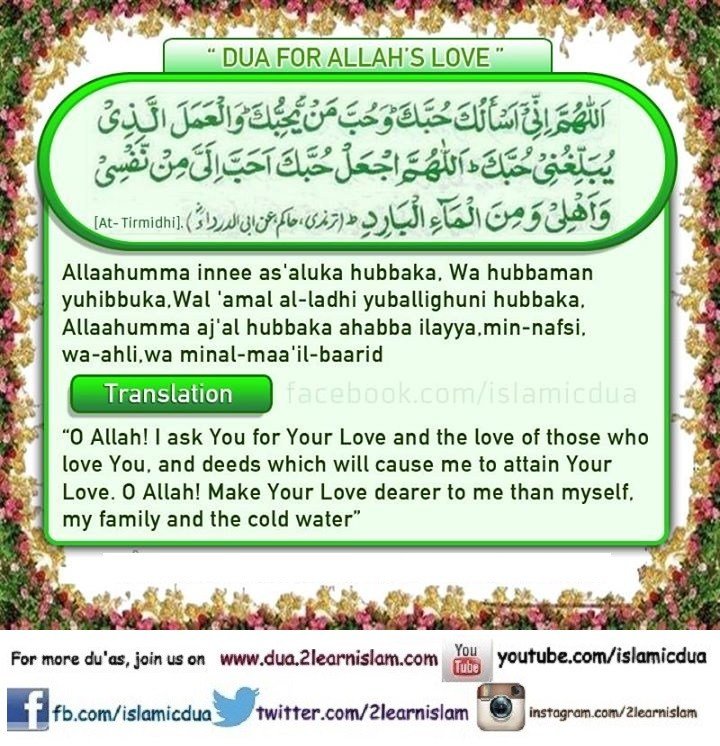
     

    Click here for this dua

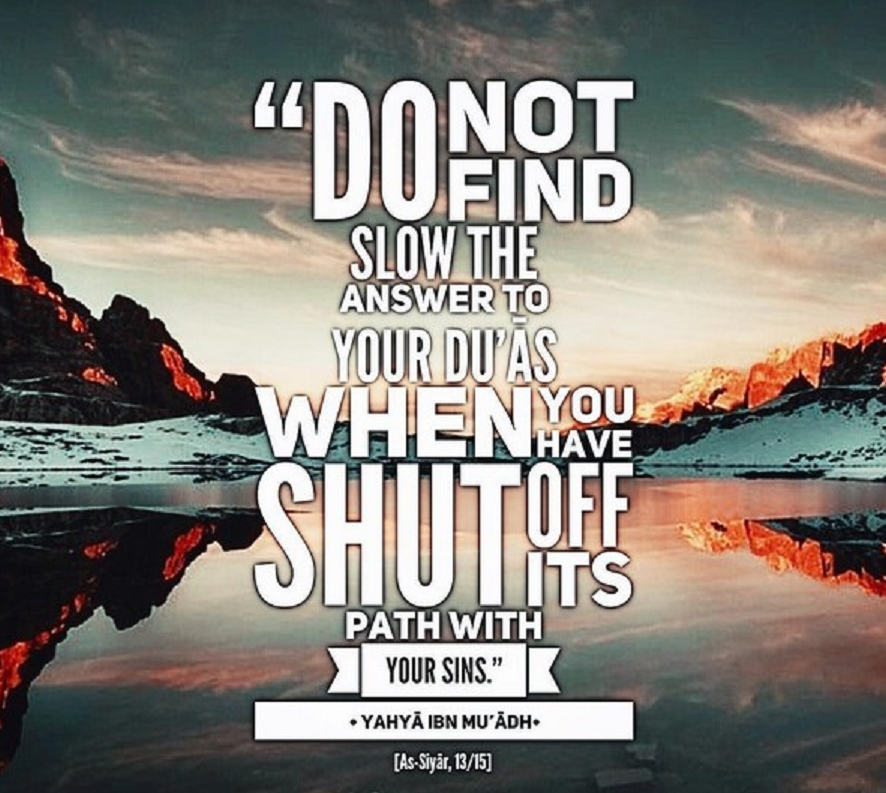
  • Why is dua not answered sometimes?

    Why is dua not answered sometimes?

    dua-reminder


    • Allaah says: ‘‘And your Lord says: Call upon Me and I will respond to your supplication. Verily those who are too arrogant to worship Me will, enter Hell in humiliation.’’ [Surah Ghaafir 40:60]
      ]
      The questioner stated that he did indeed make du’aa (supplication) to Allaah – the Mighty and Majestic – but it was not answered by Allaah. So he is in doubt with respect to this noble aayah (verse), in which Allaah promises to answer the one who supplicates to Him, and indeed Allaah – the Most Perfect – never breaks His promise.So the clarification of this is that there are certain conditions that need to be fulfilled in order for a supplication to be answered. These conditions are:


    • Firstly: Sincerity to Allaah – the Mighty and Majestic. That is to say, one must be sincere in his du’aa (supplication), so he turns to Allaah – the One free from all imperfections with an attentive heart, being truthful in his turning to Him, knowing that Allaah – the Most Perfect, the Most High – is capable of answering his du’aa (supplication) and hoping that the du’aa will be answered.
    • Secondly: During du’aa, the caller should feel that he is in need of Allaah – the Most Perfect, the Most High – in fact in dire need; and that only Allaah alone answers the supplication of the one in distress and the One who removes evil.
    • Thirdly: That the one making du’aa should refrain from haraam (unlawful) matters, as this acts as a barrier between the person and his du’aa (supplication) being answered – as has been established in the authentic hadeeth, from the Prophet (sallallaahu ’alayhi wa sallam) who said: ‘‘Indeed Allaah – the Most High -is good and accepts only that which is good. Allaah has ordered the Believers to do that which He commanded the Messengers. Allaah – the Most High -has said: ‘‘O you Messengers! Eat of the good things and do righteous actions.’’ [Surah-Mu‘minoon 3:51 ]And Allaah – the Most High – says: ‘‘O you who Believe! Eat of the good things wherewith We have provided you. ’’ [Suratul-Baqarah 2:172]Then he mentioned (the case of) a man who, having journeyed far is disheveled and dusty and who spreads out his bands to the sky (saying): ‘O Lord! O Lord,’ whilst his food is unlawful, his drink unlawful and he is nourished unlawfully. So how can he be answered!’ [2] So the Prophet (sallallaahu ’alayhi wa sallam) explained the unlikelihood that this person’s du’aa would be answered, even after fulfilling the apparent factors which aid the du’aa being answered. The apparent factors being: [i]: Raising ones’ hands towards the sky, meaning towards Allaah – the Mighty and Majestic – since Allaah is above the heavens, above His ’Arsh (Throne). Extending the hands out towards Allaah -the Mighty and Majestic – is amongst the causes of du’aa being responded to, as is shown in the narration from the Prophet (sallallaahu ’alayhi wa sallam) that he said: ‘‘Indeed your Lord is Alive, Most generous. He feels shy that when his servant raises his bands towards Him, calling upon Him, that He should return him empty, having nothing.’’[3]

    Click here to learn authentic duas from the Holy Quran and the Hadiths

    • [ii]: This man called upon Allaah – the Most High – using the name Rabb (Lord). Seeking the means of nearness to Allaah, with this name is also regarded as one of the causes for du’aa to be responded to, since the Rabb is the Creator, the Owner, the Governor of all affairs – and the reigns of the Heavens and the earth are in His Hands. Due to this, you will find that most of the supplications made in the Noble Qur‘aan are by this name: ‘‘Our Lord! We have heard the call of one calling us to faith: ‘Believe you in the Lord,’ and we have believed. Our Lord! Forgive us our sins, and remit from us our evil deeds, and take to Yourself our souls in the company of the righteous. Our Lord! Grant us what You did promise unto us through Your Messengers, and do not disgrace us on the Day of judgement, for You never break Your promise. And their Lord has accepted of them, and answered them: Never will I suffer to be lost the work of any of you, whether male or female.’’ [Soorah Aal-‘lmraan 3:193-195]
    •  [iii]: This man was a traveller, and journeying is often a cause for du’aa to be responded to, because a person feels more in need of Allaah – the Mighty and Majestic – when travelling, than when a person is resident with his family. He was dusty and dishevelled, seeming very insignificant in himself, as if the most important thing to him was to implore Allaah and to call upon Him – in any condition he may be – whether dusty and dishevelled, or in ease and oppulance. Being dusty and dishevelled is also instrumental, like in the hadeeth attributed to the Prophet (sallallaahu ’alayhi wa sallam) in which he said: Indeed Allaah boasts to the people of the Heaven about the people standing at ’Arafah, saying: ‘‘Look at My servants who have come to Me dusty and dishevelled.’’ [4] However, these factors did not bring about anything, because his food, his nourishment and his clothing were all haraam (unlawful). So the Prophet (sallallaahu ’alayhi wa sallam) remarked: ‘‘So how can he be answered!’’

    Therefore, if these conditions are not satisfied, then the question concerning the du’aa (supplication) being answered will seem distant. However, if the conditions are satisfied and the one supplicating is still not answered, then this is due to a wisdom which Allaah – the Mighty and Majestic – knows, and the one supplicating does not know what this wisdom is; and maybe that you like a thing and it is bad for you.

    So when these conditions are fulfilled and the one supplicating is not answered, then either he has been protected from an evil which is greater than what he has asked for, or Allaah stores it for him until the Day of Resurrection, and he then gets a greater reward.

    This is so, because the one who makes du’aa – calling upon Allaah alone, fulfilling the conditions and not being answered, but rather being saved from a greater evil – is in the position of having carried out the causes yet has been prevented from being answered, and therefore has a two-fold reward. One reward for making du’aa (supplication), and another reward for bearing the trial of not being answered. So that which is greater and more complete is stored for him with Allaah – the Mighty and Majestic.

    Also of importance is that the one supplicating should not express dissatisfaction if his du’aa is apparently not being answered, for this action in itself is a reason for the du’aa not being answered – as the Prophet (sallallaahu ’alayhi wa sallam) said:

    ‘A servants du’aa continues to be answered as long as be does not ask for anything sinful or breaking the ties of relations, and as long as be does not become impatient.’’ It was said: How does one become impatient O Messenger of Allaah? He said: ‘‘He says: I have supplicated, I have supplicated, yet it has not been answered.’’ [5] He therefore becomes despondent and abandons supplicating. So it is not befitting that the one supplicating should become impatient about being answered, then become disappointed and despondent, and thereby abandon making du’aa. Rather, one should call upon Allaah, since every du’aa you make to Allaah is an act of worship, which brings you closer to Him and increases your reward.

    So my brother, you should take to making du’aa (supplication) in all affairs, be it general or specific, in difficulty or in ease. And if it was that supplication was only a means of worshipping Allaah – the One free from all imperfections, the Most High – then that would be sufficient. So it is more befitting that a person strives in this – and with Allaah lies the success and the ability.’’
    [1] Majmoo’ul-Fataawaa war-Rasaa‘il (no. 155)
    [2] Related by Muslim (no. 1015) from Aboo Hurayrah (radiyallaahu ’anhu)
    [3] Saheeh: Related by Ahmad (5/438) and Aboo Daawood (no. 1488). It was authenticated by al-Haafidh Ibn Hajar in Fathul-Baaree (11/143).

  • Seek Allah’s Forgiveness

    Seek Allah’s Forgiveness


    The Encouragement to Seek Allah’s Forgiveness, and Warning to those who Falsely Accuse Innocent People

    Allah emphasizes His generosity and kindness, in that He forgives whoever repents to Him from whatever evil they commit.

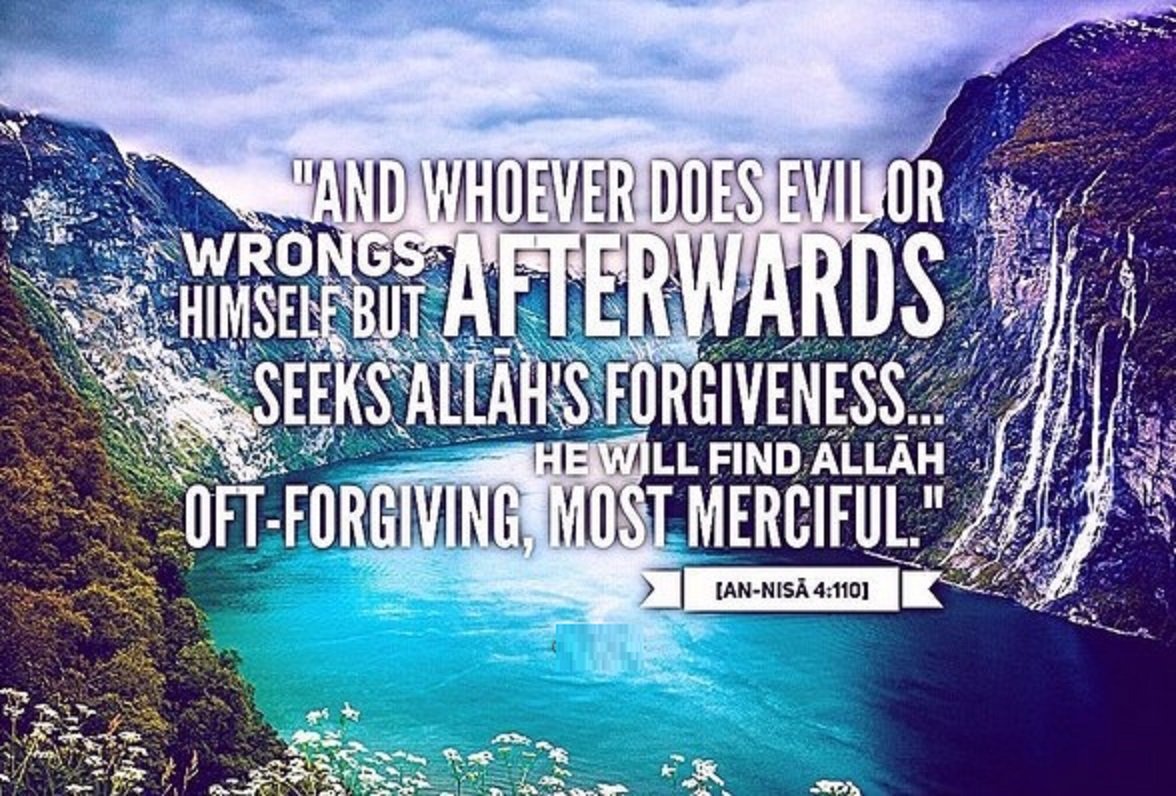
    Allah said, [وَمَن يَعْمَلْ سُوءاً أَوْ يَظْلِمْ نَفْسَهُ ثُمَّ يَسْتَغْفِرِ اللَّهَ يَجِدِ اللَّهَ غَفُوراً رَّحِيماً ]

    (And whoever does evil or wrongs himself but afterwards seeks Allah’s forgiveness, he will find Allah Oft-Forgiving, Most Merciful.)

    Ali bin Abi Talhah said that Ibn `Abbas commented about this Ayah, “Allah informs His servants of His forgiveness, forbearing generosity and expansive mercy. So whoever commits a sin, whether minor or major, [ثُمَّ يَسْتَغْفِرِ اللَّهَ يَجِدِ اللَّهَ غَفُوراً رَّحِيماً] (but afterwards seeks Allah’s forgiveness, he will find Allah Oft-Forgiving, Most Merciful.) even if his sins were greater than the heavens, the earth and the mountains.”

    Imam Ahmad recorded that `Ali said, “Whenever I hear anything from the Messenger of Allah, Allah benefits me with whatever He wills of that. Abu Bakr told me, and Abu Bakr has said the truth, that the Messenger of Allah said, «مَا مِنْ مُسْلِمٍ يُذْنِبُ ذَنْبًا، ثُمَّ يَتَوَضَّأُ فَيُصَلِّي رَكْعَتَيْنِ، ثُمَّ يَسْتَغْفِرُ اللهَ لِذلِكَ الذَّنْبِ، إِلَّا غَفَرَ لَه»

    (No Muslim commits a sin and then performs ablution, prays two Rak`ahs and begs Allah for forgiveness for that sin, but He forgives him.)

    Click here to learn a beautiful dua for seeking forgiveness of sins

    He then recited these two Ayat, [وَمَن يَعْمَلْ سُوءاً أَوْ يَظْلِمْ نَفْسَهُ] (And whoever does evil or wrongs himself), and, [وَالَّذِينَ إِذَا فَعَلُواْ فَـحِشَةً أَوْ ظَلَمُواْ أَنْفُسَهُمْ] (And those who, when they have committed Fahishah or wronged themselves with evil).”

    Allah’s statement, [وَمَن يَكْسِبْ إِثْماً فَإِنَّمَا يَكْسِبُهُ عَلَى نَفْسِهِ] (And whoever earns sin, he earns it only against himself.) is similar to His statement,

    (And no bearer of burdens shall bear the burden of another). So no one will avail anyone else. Rather, every soul, and none else, shall carry its own burden. This is why Allah said, [وَكَانَ اللَّهُ عَلِيماً حَكِيماً] (And Allah is Ever All-Knowing, All-Wise.) meaning, this occurs due to His knowledge, wisdom, fairness and mercy.


  • The ANGEL waits

    The ANGEL waits


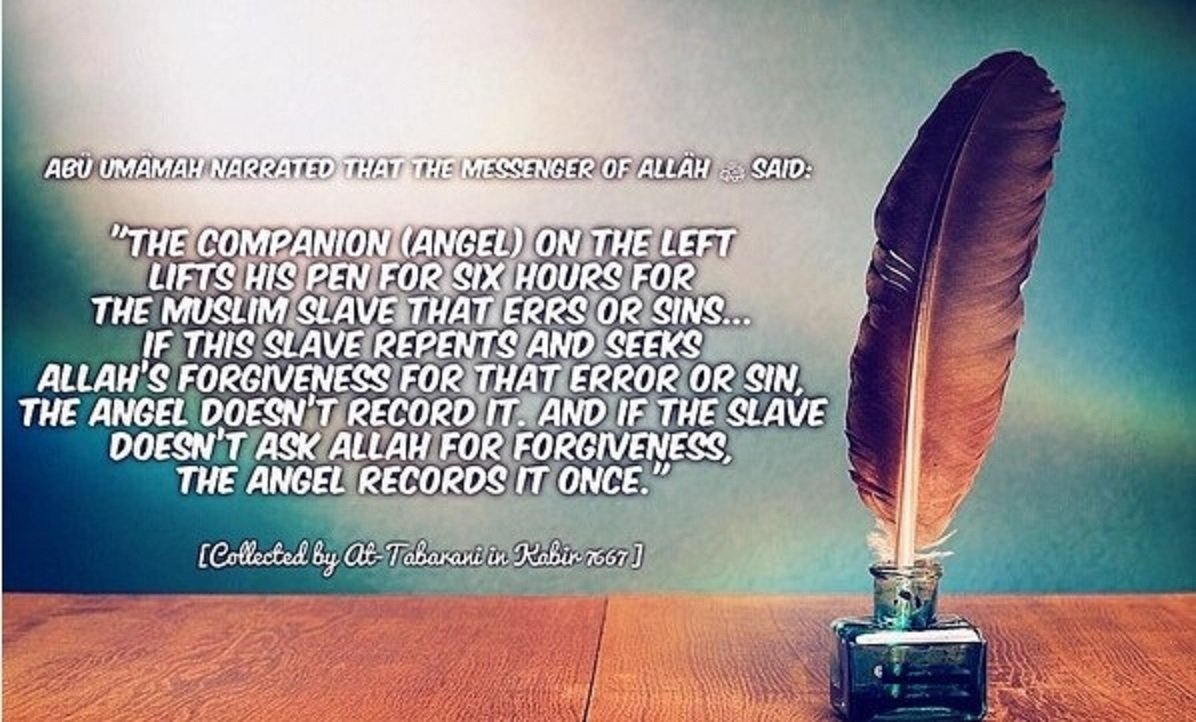
    ”The companion (Angel) on the left lifts his pen for six hours for the Muslim slave that errs or sins. If this slave repents and seeks Allah’s forgiveness for that error or sin, the Angel does not record it. And if the slave does not ask Allah for forgiveness, the Angel records it once.”

    The Prophet ﷺ through Abu Umamah. [Collected by At-Tabarani in Kabir (7667), Abu Na’eem in Hilya (6/124), Al-Bayhaqi in Shu’ib (6788). Shaykh Al-Albaani graded it (Hasan) in his Saheehah (1209)].


    Benefits for this topic:

    Lifts the pen for six hours: These six hours could refer to astrological time, or another time period.

    The Muslim slave that errs or sins: Means the Angel won’t record the sin or error before the six hours passes. He simply delays writing it.

    If the slave repents: This refers to the salve seeking sincere repentance for the sin or error he’s done.

    The Angel doesn’t record it: Means the Angel on the left ignores writing it.

    If the slave doesn’t ask Allah for forgiveness: This means the Angel on the left writes it down as one bad deed, unlike the Angel that records the good deeds. The Angel on the right writes down a good deed ten times.[ Faydul Qadir Al-Manawee].

    Click here to learn one of the BEST DU’AS to seek FORGIVENESS of your sins.


  • The Mansions in Jannah

    The Mansions in Jannah


    “The mansions in Jannah are built based on dhikr. If you stop dhikr, the Angels stop building the mansion.”

    Ibn al-Qayyim
    [al-Waabil p.159]

    Click here for a short and beautiful dhikr to glorify Allah Subhaanahu wata’ala.


    Recite three times in Arabic upon rising in the morning

    “Glory is to Allah and praise is to Him, by the multitude of His creation, by His Pleasure, by the weight of His Throne, and by the extent of His Words. ”

    سُبْحَانَ اللهِ وَبِحَمْدِهِ عَدَدَ خَلْقِهِ، وَرِضَا نَفْسِهِ، وَزِنَةَ عَرْشِهِ وَمِدَادَ كَلِمَاتِهِ

    Subhaanallaahi wa bihamdihi: ‘Adada khalqihi, wa ridhaa nafsihi, wa zinata ‘arshihi wa midaada kalimaatihi.

    Muslim 4/2090.


    Click here to download the pic of this meritorious dhikr

  • Stay Patient during tough times

    Stay Patient during tough times

    reminder8

    Stay PatientIf your heart feels PAIN and you are HURT or upset because of a calamity that has befallen you, you should endure that with patience and make dua to Allah, confide and rely only on Him instead of turning to other people.

    In Yaqoob (alahissalaam), there lies an example for the believers, that it is okay to be sad and grieved but be patient and cry unto Allah Almighty. When he was separated from his son Yusuf alaihisallam, he did not whine in front of anyone, rather he remained steadfast for years and sought help from Allah subhaanahu wa taa’aala and eventually he was reunited with his son.

    He said :“I only complain of my suffering and my grief to Allah” (12:86)
    Indeed, no one despairs of relief from Allah except the disbelieving people.” (12:87)

    May Allah bless us with an unfaltering imaan, a heart that never runs out of patience and a soul that has complete tawakkul (faith) in Him and never disobeys Him, ameen

    Click here to learn a beautiful Dua for Patience, Success and victory over your Enemies

  • Overcome your Stress, grief and sorrow

    Overcome your Stress, grief and sorrow

    reminder

    Are you SAD or HURT because you lost something? Are you feeling down because your plans didn’t work out?


    Did you lose a job, someone you loved or could not go where you wanted to?

    Read the following verse of the Holy Quran to understand why this happened.

    “But perhaps you hate a thing and it is good for you; and perhaps you love a thing and it is bad for you. And Allah Knows, while you know not” – (Surat Al-Baqarah:216)”

    Many a times we fail to comprehend the wisdom behind Allah’s plans. But we must have faith in Him and where He takes us. He is the ALL- KNOWER; He knows what we don’t. Whatever He makes us go through is for our own good.

    May Allah always make us trust His plans, ameen

    Click here to learn a beautiful dua for Istikhara (to seek Allah’s counsel), to ask Allah to guide you towards the best


  • Am I one of those who justify his haram (forbidden) acts?

    Am I one of those who justify his haram (forbidden) acts?

    reminder1

    Am I one of those who justify his haram (forbidden) acts?

    A very important question we all need to ask ourselves.

    Justifying Evil Deeds

    Imam Sadiq had heard that an old man had become famous for his piety. One day, he saw him surrounded by a large crowd. A little later, the man came out of the crowd and distancing himself from them, proceeded alone, whereupon the Imam began to follow him.

    After a short time, the Imam observed that he had stopped near a bakery from where he stealthily picked up two loaves of bread. After a short distance, he stopped at a fruit store, picking up two pomegranates in the same manner and once again continued on his way.

    As he walked further, the old man approached a sick person, handed over the loaves and fruits to him and was about to move on when Imam Sadiq came up to him and said, “I have witnessed something greatly astonishing from you”, and then proceeded to narrate the acts, which he had witnessed.

    The old man said, “I suppose you are Imam Sadiq”

    The Imam replied in the affirmative.

    The man continued, “It is really unfortunate that in spite of being of the progeny of the Holy Prophet (Peace be upon him) you do not seem to know anything.”

    The Imam asked, “What act of ignorance have you noticed from me?”

    The man said, “But do you not know that God has said in the Quran “Whoever brings a good deed, he shall have ten like it and whoever brings an evil deed, he shall be recompensed only with the like of it”.

    On this basis, since I have stolen two fruits and two loaves of bread, I have four sins in my account, but on the other hand, since I have given it in the way of God, I have earned forty good deeds. Reducing four from forty, I still have thirty-six good deeds in my account; a pity that you possess no knowledge of such computations!”

    The Imam explained to him, “But have you not heard this verse of the Quran, which says: “Allah only accepts from those who guard (against evil)”. You have earned four sins by stealing those four items and four more sins for giving them to someone else without the permission of the owners, so you have collected eight sins but not a single good deed.”

    Later, the Imam said to his companions, “With such interpretations and justifications, not only do they mislead themselves, but others as well.”

    Imam Sadiq has said:
    (Surely, the effect of an evil deed upon the doer is faster than that of a knife upon a piece of meat.)

    Click here to learn a beautiful Dua to gain MERCY of Allah & FORGIVENESS of your sins


  • BE KIND TO your CHILDREN and TREAT THEM EQUALLY

    BE KIND TO your CHILDREN and TREAT THEM EQUALLY

    children

    We should keep the following hadiths in mind when dealing with our children:

    Abu Huraira Radi Allahu anhu reported that al-Aqra’ bin Habis saw Allah’s Apostle (may peace be upon him) kissing Hasan Radi Allahu anhu. He said: I have ten children, but I have never kissed any one of them, whereupon Allah’s Messenger (may peace be upon him) said: He who does not show mercy (towards his children), no mercy would be shown to him.
    Muslim :: Book 30 : Hadith 5736

    The Prophet (peace be upon him) said, “He is not of us who does not have mercy on young children, nor honor the elderly”
    (At-Tirmidhi)

    The Prophet (peace be upon him) said: Act equally between your children; Act equally between your sons.
    Sunan of Abu-Dawood Hadith 3537,Narrated by An-Nu’man ibn Bashir

    ‘A’isha (Allah be pleased with her) reported that there came a few desert Arabs to Allah’s Messenger (may peace be upon him) and said: Do you kiss your children? He said: Yes. Thereupon they said: By Allah but we do not kiss our children. Thereupon Allah’s Messenger (may peace be upon him) said: Then what can I do if Allah has deprived you of mercy? Ibn Numair said: ( has deprived) your heart of mercy.
    Muslim :: Book 30 : Hadith 5735

    The Apostle of Allah (peace be upon him) came to some children who were playing: He greeted them lovingly.
    Sunan of Abu-Dawood Hadith 5183,Narrated by Anas ibn Malik

    Al-Bara’ said, “I saw the Prophet, may Allah bless him and grant him peace, when al-Hasan Radi Allahu anhu was on his shoulder. He was saying, ‘O Allah, I love him, so love him.’”

    I prayed along with Allah’s Messenger (peace be upon him) the first prayer. He then went to his family and I also went along with him when he met some children (on the way). He began to pat the cheeks of each one of them. He also patted my cheek and I experienced a coolness or a fragrance of his hand as if it had been brought out from the scent bag of a perfumer.
    Sahih Muslim Hadith 5758

    Click here to learn a beautiful “Dua to have Pious, Obedient Children”

  • Are you a carrier of the Holy Quran?

    Are you a carrier of the Holy Quran?

    reminder3

    The carriers of the Qur’an are recognized by their nights (standing in prayer) when the people are asleep,

    by their days fasting when the people are feasting,

    by their caution when the people mix [the lawful and the unlawful],

    by their humility when the people are arrogant,

    by their sobriety when the people are frivolous,

    by their weeping when the people are laughing,

    and by their silence when the people chatter.

    Abdullah bin Mas‘ūd


    Click here to learn a beautiful Dua for Guidance, Piety and righteousness